
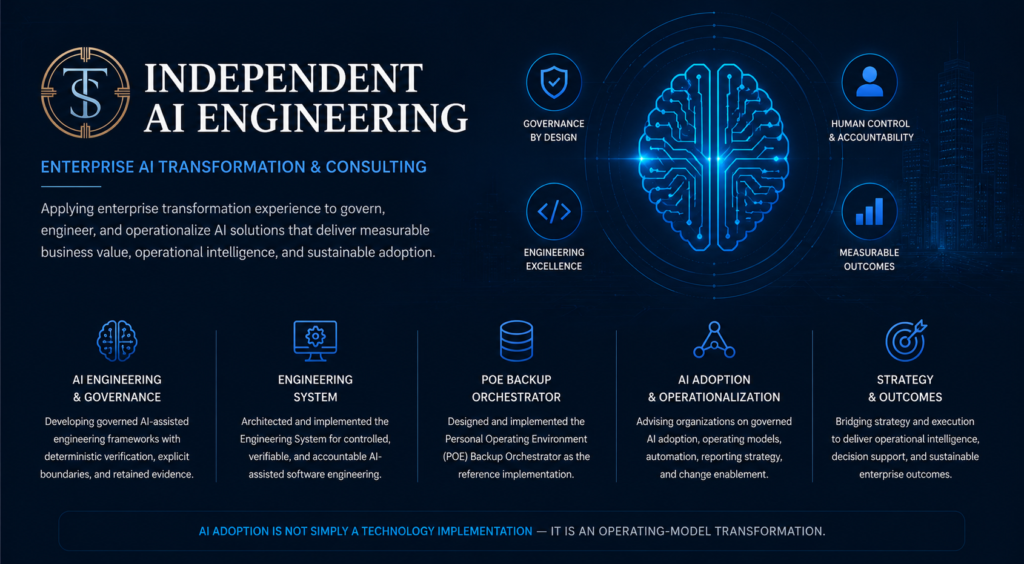
Independent AI Engineering & Enterprise Transformation
Enterprise AI Transformation | Governed AI Engineering | Operational Intelligence
Independent | 2025–Present
Following my most recent enterprise engagement, I have focused my independent work on applying decades of enterprise transformation, program leadership, automation, governance, and operational intelligence experience to the emerging challenge of enterprise AI adoption and operationalization.
Rather than approaching AI as an isolated technology implementation, my work examines the broader operating model required to introduce AI responsibly into complex organizations: architecture, governance, human accountability, engineering controls, verification, organizational adoption, operational intelligence, and measurable business outcomes.
This work has evolved from research and experimentation into the design and implementation of working systems, engineering methods, governance controls, and reference architectures intended to demonstrate how AI-assisted capabilities can be developed and operated with enterprise-grade discipline.
Governed AI-Assisted Engineering
I designed and implemented an Engineering System for governed AI-assisted software development. The system establishes an architecture-first development methodology in which AI can accelerate engineering activity without assuming unrestricted authority over design, implementation, verification, or release decisions.
The Engineering System combines bounded AI authority with deterministic verification, lifecycle evidence, architectural controls, explicit acceptance criteria, and accountable human decision-making. AI operates within defined engineering boundaries while critical decisions and final authority remain under human control.
The objective is straightforward: capture the acceleration available from AI while preserving the engineering discipline, traceability, accountability, and quality required in enterprise environments.
Personal Operating Environment (POE) Backup Orchestrator
To prove that the Engineering System could govern actual software development rather than remain a theoretical framework, I designed and built the Personal Operating Environment (POE) Backup Orchestrator as its reference implementation.
The POE Backup Orchestrator provided a substantive engineering workload through which architecture controls, bounded AI participation, verification gates, testing, retained evidence, and certification practices could be exercised throughout a real development lifecycle.
The project demonstrated that AI-assisted development can operate within a controlled engineering system while still achieving substantial development velocity. At its certification milestone, the implementation had achieved 1,075 passing tests, providing objective evidence that the methodology had moved beyond concept into demonstrated practice.
From Engineering to Enterprise AI Adoption
The Engineering System and POE work led naturally to a broader question: How should an enterprise operationalize AI once individual AI capabilities move beyond experimentation?
That question is driving the development of Phronesis, an emerging operational-intelligence platform architecture intended to extend governed AI principles beyond software engineering into enterprise operations.
Phronesis explores the integration of enterprise information, contextual intelligence, automation, governance, and controlled action into an operating model designed to transform information into knowledge, knowledge into understanding, and understanding into action.
The work remains architectural and developmental, but it represents the progression from governing how AI-enabled systems are engineered toward governing how AI participates in enterprise operations.
Enterprise AI Adoption & Operationalization
My independent work has also broadened into the organizational dimensions of AI transformation. Sustainable enterprise adoption requires more than models, agents, or automation. It requires alignment across:
- AI governance and accountable human authority
- Architecture and engineering standards
- Enterprise knowledge and information management
- Operational processes and workflow integration
- Verification, evidence, risk, and control mechanisms
- Organizational readiness and change enablement
- Measurement of adoption, performance, and business outcomes
This perspective draws directly on my previous work across enterprise transformation, PMO governance, financial systems, operational resilience, automation, data and reporting, SDLC governance, and complex technology delivery.
Current Focus
My current work sits at the intersection of enterprise transformation leadership and hands-on AI engineering.
I am continuing to develop and refine governed AI engineering methods, operational-intelligence architectures, enterprise AI adoption models, and practical implementations that explore how organizations can move from AI experimentation to sustainable enterprise capability.
The underlying principle remains consistent with my broader career: technology creates durable value when strategy, governance, execution, information, and operational accountability function as an integrated system.
Core Areas
Enterprise AI Adoption & Transformation
Operating models, governance structures, adoption strategy, organizational readiness, and measurable value realization.
Governed AI Engineering
Architecture-first engineering, bounded AI authority, deterministic verification, retained evidence, lifecycle governance, and accountable human control.
AI-Enabled Operational Intelligence
Using AI, enterprise knowledge, contextual information, analytics, and automation to improve visibility and decision support.
Automation & Workflow Transformation
Applying AI and automation to reduce manual effort, improve process consistency, and strengthen execution.
Enterprise Governance & Execution
Connecting AI initiatives to established disciplines in portfolio management, SDLC governance, risk management, reporting, and enterprise transformation.
Human/AI Operating Models
Defining where AI can act autonomously, where human judgment remains authoritative, and how those boundaries can be governed and verified.
AI adoption is not simply a technology implementation. It is an operating-model transformation requiring governance, engineering discipline, organizational change, and accountable execution.
Ready to Transform
Let’s discuss how tailored technology leadership can drive your enterprise forward.