
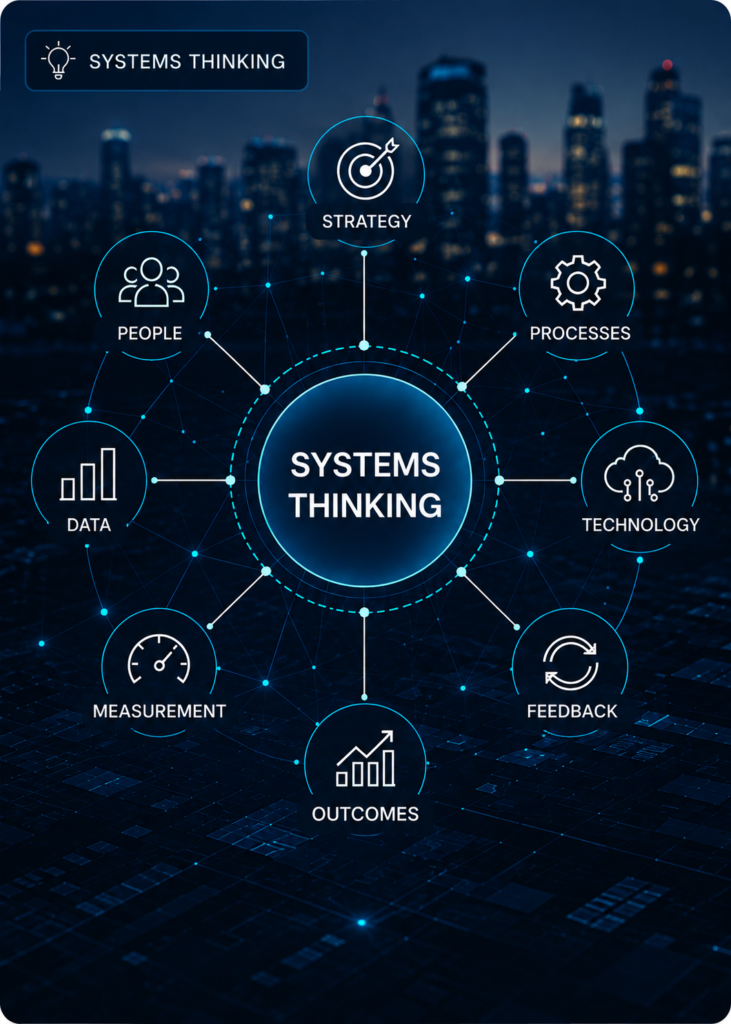
Enterprise technology environments are not isolated collections of projects, applications, and teams. They are interconnected operational systems where governance, reporting, automation, people, processes, and technology continuously influence one another.
Organizations often struggle not because individual components fail, but because the relationships between those components are poorly understood. Visibility gaps, fragmented reporting, disconnected workflows, and misaligned governance structures create operational friction that compounds over time.
Systems thinking provides a framework for understanding enterprise operations holistically. Rather than focusing exclusively on isolated initiatives, systems-oriented leadership evaluates how information flows, how decisions propagate, where operational bottlenecks form, and how execution quality is influenced across interconnected teams and processes.
In enterprise technology leadership, this perspective becomes critical. Large organizations operate through layers of dependencies involving infrastructure, financial systems, reporting ecosystems, governance controls, operational procedures, and cross-functional delivery teams. Improvements made in one area often create downstream effects elsewhere — either strengthening operational performance or introducing additional complexity.
One of the most important principles of systems thinking is recognizing leverage points. In many cases, relatively small improvements in operational visibility, automation, workflow alignment, or reporting accuracy can create disproportionately large improvements in execution quality and organizational performance.
This is particularly evident in enterprise governance and PMO environments. Organizations frequently generate enormous volumes of reporting while still lacking meaningful operational intelligence. Data alone does not create clarity. Effective operational intelligence requires structured measurement, contextual visibility, disciplined governance, and feedback mechanisms capable of supporting informed decision-making.
Automation also plays a significant role within systems-oriented enterprises. The objective of automation should not simply be task elimination. Properly implemented automation reduces friction, improves consistency, accelerates information flow, and allows skilled professionals to focus on higher-value analytical and strategic work.
Enterprise transformation initiatives succeed most consistently when organizations align:
- strategy,
- governance,
- operational visibility,
- process discipline,
- reporting intelligence,
- and execution management
into a coherent operational framework.
Technology leadership therefore becomes less about managing isolated projects and more about orchestrating adaptive operational systems capable of sustaining execution quality at scale.
As enterprise environments continue to grow more complex, organizations that adopt systems-oriented operational models will be better positioned to improve governance, accelerate decision-making, modernize execution, and integrate AI-enabled operational intelligence into their broader transformation strategies.