
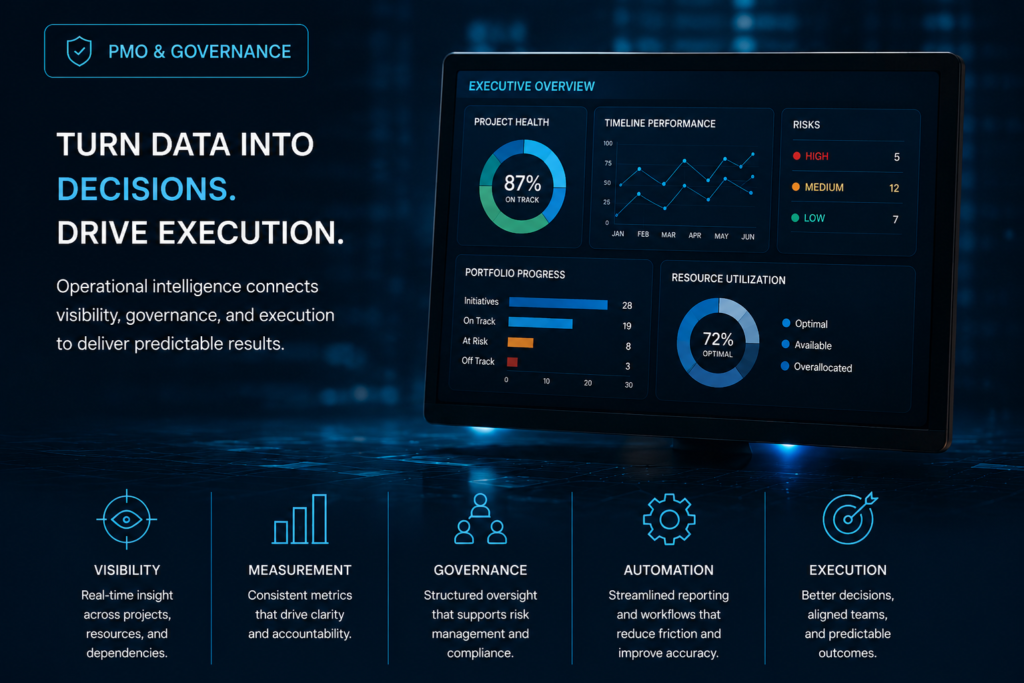
Enterprise execution quality is directly tied to operational visibility. Organizations cannot effectively govern, prioritize, coordinate, or execute what they cannot clearly see.
In many enterprise environments, leadership teams are surrounded by large volumes of reporting, dashboards, status updates, and operational metrics — yet still struggle to maintain meaningful visibility into actual execution health. Data exists, but operational intelligence is often fragmented, delayed, inconsistent, or disconnected from decision-making processes.
Operational intelligence addresses this problem by transforming raw operational data into structured visibility capable of supporting enterprise execution.
At its core, operational intelligence integrates:
- reporting,
- governance,
- automation,
- workflow visibility,
- execution measurement,
- and real-time operational feedback
into a unified management framework.
The objective is not simply to generate more reporting. The objective is to create actionable visibility that improves decision quality, execution coordination, accountability, and organizational responsiveness.
This becomes increasingly important in large enterprise environments where:
- projects are interconnected,
- dependencies span multiple business units,
- operational risk evolves continuously,
- and execution complexity compounds over time.
Without operational intelligence, organizations often experience:
- delayed decision-making,
- fragmented governance,
- conflicting priorities,
- reporting inconsistencies,
- hidden execution risks,
- and inefficient coordination between teams.
Operational intelligence reduces these gaps by creating structured transparency across enterprise delivery ecosystems.
In PMO and enterprise governance environments, this can include:
- automated reporting pipelines,
- portfolio health visibility,
- dependency tracking,
- KPI measurement,
- workflow automation,
- risk aggregation,
- deployment readiness tracking,
- and executive operational dashboards.
When integrated effectively, these systems allow leadership teams to identify execution bottlenecks earlier, prioritize resources more effectively, and maintain stronger alignment between strategic objectives and operational delivery.
One of the most important characteristics of operational intelligence is feedback velocity. Organizations that can rapidly gather, interpret, and respond to operational information are significantly more adaptive than organizations dependent on slow, manually assembled reporting structures.
Automation plays a critical role in enabling this responsiveness. Automated workflows, reporting orchestration, AI-assisted analysis, and integrated operational dashboards reduce reporting latency while improving data consistency and execution visibility.
This creates a shift from reactive management toward proactive operational governance.
Operational intelligence also strengthens accountability. When visibility is clear, measurable, and consistently structured, organizations gain improved alignment between leadership expectations, operational performance, and delivery execution.
As enterprise systems continue to increase in complexity, organizations that successfully integrate operational intelligence into governance, reporting, automation, and execution management frameworks will be better positioned to:
- improve decision quality,
- accelerate execution,
- modernize governance,
- reduce operational friction,
- and sustain enterprise transformation initiatives at scale.
Execution excellence is rarely accidental. It is the product of visibility, measurement, coordination, governance, and disciplined operational intelligence working together as an integrated enterprise system.