
Executive Summary
While initially hired by Inspirata as an Implementation Manager, I was quickly reassigned to lead the organization’s Natural Language Processing (NLP) program under the direction of the Informatics Product organization.
At the time, Inspirata was building a next-generation oncology information platform designed to aggregate, normalize, enrich, and distribute large-scale cancer-related clinical and operational data for enterprise healthcare and research consumption.
The initiative combined:
- AI and machine learning,
- NLP-based text mining,
- enterprise data integration,
- data quality management,
- master data management,
- analytics,
- and large-scale healthcare data orchestration
within a unified operational framework.
Although the organization possessed a strong conceptual vision for the platform, substantial uncertainty remained regarding how the end-to-end operational workflows, system integrations, data pipelines, and AI/NLP orchestration layers would function cohesively at enterprise scale.
Working closely with data scientists, engineers, architects, and operational leadership, I helped operationalize the platform vision by designing detailed end-to-end workflow architecture, developing executable prototype pipelines, validating integration strategies, and coordinating global NLP program execution activities.
The resulting framework established the operational foundation for Inspirata’s AI-enabled oncology data platform while supporting future expansion of NLP-driven healthcare analytics and revenue-generating capabilities.
Business Context
Inspirata was developing a large-scale oncology information ecosystem intended to support:
- cancer research,
- clinical intelligence,
- healthcare analytics,
- operational reporting,
- and AI-enabled healthcare applications.
The platform strategy centered around creating a centralized “Cancer Information Data Trust” capable of:
- ingesting structured and unstructured healthcare information,
- cleansing and normalizing data,
- enriching records through AI/NLP processing,
- and distributing validated information across multiple downstream systems and analytical environments.
The architecture involved integration across:
- proprietary Inspirata systems,
- third-party healthcare platforms,
- NLP engines,
- machine learning workflows,
- enterprise data warehouses (EDWs),
- data marts,
- and operational applications.
At the time, the organization had established the high-level strategic vision for the platform but faced significant challenges translating that vision into an executable operational architecture capable of supporting scalable enterprise deployment.
Operational Challenge
The complexity of the initiative extended far beyond conventional software implementation.
The organization faced several critical challenges, including:
- orchestrating highly complex end-to-end healthcare data workflows,
- integrating multiple proprietary and third-party technologies,
- coordinating AI/NLP processing loops,
- maintaining performance and scalability,
- controlling infrastructure cost,
- and validating architectural feasibility before making long-term platform commitments.
A major operational concern involved determining how data would:
- move through the platform,
- interact with AI/NLP processing engines,
- be cleansed and normalized,
- feed downstream applications,
- and ultimately support enterprise analytics and healthcare intelligence use cases.
The initiative required not only technical integration planning, but also operational clarity around:
- workflow sequencing,
- data transformation,
- orchestration dependencies,
- governance,
- and enterprise scalability.
Without a validated operational framework, the organization risked making significant architectural and investment decisions without fully understanding how the platform would function cohesively in production environments.
Transformation Opportunity
Rather than approaching the challenge strictly from a systems integration perspective, I viewed the initiative as an operational architecture and workflow orchestration problem.
The opportunity involved transforming a conceptual AI/NLP healthcare vision into a structured, executable operational framework capable of supporting:
- enterprise-scale healthcare data processing,
- AI-enabled enrichment workflows,
- operational intelligence,
- and scalable downstream consumption models.
To accomplish this, the organization required:
- detailed workflow mapping,
- executable prototype validation,
- systems orchestration modeling,
- and operational alignment across engineering, data science, and product organizations.
The objective was not merely to design isolated technical components, but to establish a cohesive operational ecosystem capable of supporting real-world healthcare data processing and enterprise analytics workflows.
Solution Development
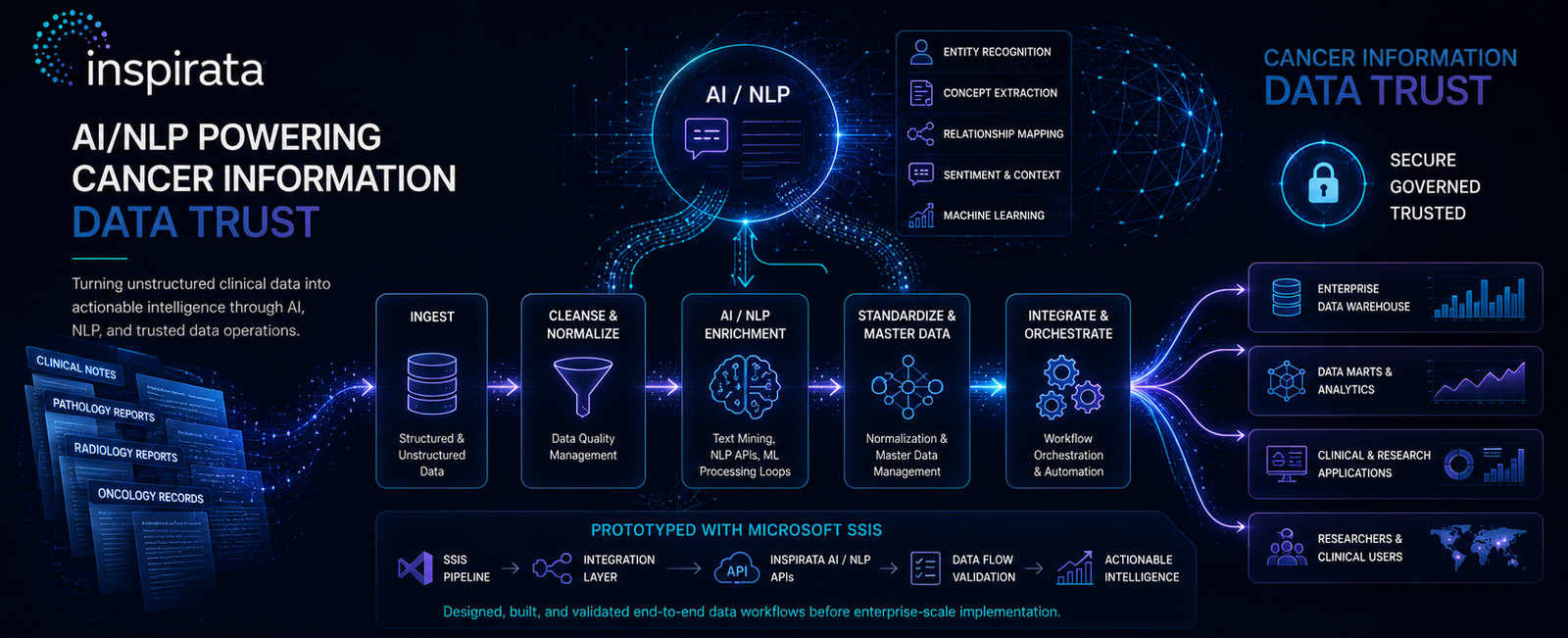
Working directly with architects, engineers, data scientists, and product leadership, I mapped the end-to-end operational workflow architecture governing the movement and transformation of data throughout the platform ecosystem.
To validate the operational design before large-scale implementation commitments were made, I personally designed and built a working prototype pipeline leveraging Microsoft SQL Server Integration Services (SSIS) integrated with Inspirata-developed AI and NLP APIs.
The prototype simulated the operational movement of data through:
- ingestion,
- cleansing,
- normalization,
- AI/NLP enrichment,
- transformation,
- and downstream distribution workflows.
The architecture incorporated:
- machine learning and NLP processing loops,
- operational routing logic,
- data quality management workflows,
- master data management concepts,
- and enterprise distribution pipelines supporting EDWs, data marts, and application-layer consumption.
Although the prototype was not intended to become production software, it served as a critical operational validation framework that allowed the organization to:
- visualize end-to-end workflow behavior,
- evaluate architectural feasibility,
- reduce implementation uncertainty,
- validate systems integration assumptions,
- and make informed platform design decisions.
The effort helped stabilize organizational uncertainty during the early stages of the initiative by transforming abstract architectural concepts into executable operational models.
NLP Program Leadership
In addition to workflow architecture and platform orchestration activities, I was placed in charge of Inspirata’s NLP program following the acquisition of a new company and expansion of the organization’s AI/NLP capabilities.
Working alongside:
- data scientists,
- engineers,
- architects,
- and operational stakeholders,
I helped coordinate the integration and operational utilization of the acquired NLP capabilities while identifying opportunities to expand AI/NLP-driven business functionality and future revenue streams.
The role required balancing:
- operational execution,
- AI/NLP program coordination,
- technical integration strategy,
- and business enablement objectives
within a rapidly evolving healthcare technology environment.
Leadership & Execution
The initiative required close collaboration across:
- Informatics Product leadership,
- engineering organizations,
- AI and machine learning teams,
- data scientists,
- healthcare technology stakeholders,
- and operational delivery resources.
My role extended beyond traditional implementation management and included:
- operational workflow architecture,
- enterprise systems orchestration,
- prototype design,
- integration strategy,
- cross-functional coordination,
- AI/NLP operationalization,
- and transformation leadership.
A key element of the engagement involved creating operational clarity within a highly complex and evolving technical environment where strategic vision existed but execution pathways required refinement and validation.
Operational Outcomes
The initiative established foundational operational architecture supporting Inspirata’s broader oncology data platform strategy and AI/NLP ecosystem.
Key outcomes included:
- validated end-to-end workflow orchestration,
- improved operational understanding of platform architecture,
- reduced implementation uncertainty,
- improved integration planning,
- accelerated architectural decision-making,
- scalable healthcare data pipeline design,
- and enhanced operational alignment between product, engineering, and AI/NLP teams.
The prototype and workflow modeling efforts also helped demonstrate the feasibility of integrating:
- AI/NLP enrichment workflows,
- healthcare data normalization,
- enterprise analytics distribution,
- and operational intelligence processing
within a unified platform architecture.
Additionally, the initiative contributed to the organization’s ability to explore expanded NLP-driven business opportunities and future healthcare analytics capabilities.
Strategic Insight
This initiative reinforced the principle that enterprise AI programs succeed not through isolated algorithms alone, but through the operational systems architecture surrounding them.
AI, NLP, and machine learning capabilities only become enterprise-capable when supported by:
- scalable workflow orchestration,
- structured data pipelines,
- operational governance,
- systems integration,
- and executable operational design.
The project also demonstrated the importance of prototype-driven architectural validation in reducing enterprise implementation risk within highly complex and rapidly evolving technology environments.
Long before AI operationalization became a mainstream enterprise discipline, this initiative represented an early example of combining:
- AI/NLP enablement,
- healthcare data intelligence,
- workflow orchestration,
- enterprise integration,
- and operational systems thinking
into a cohesive large-scale transformation framework.