
Executive Overview
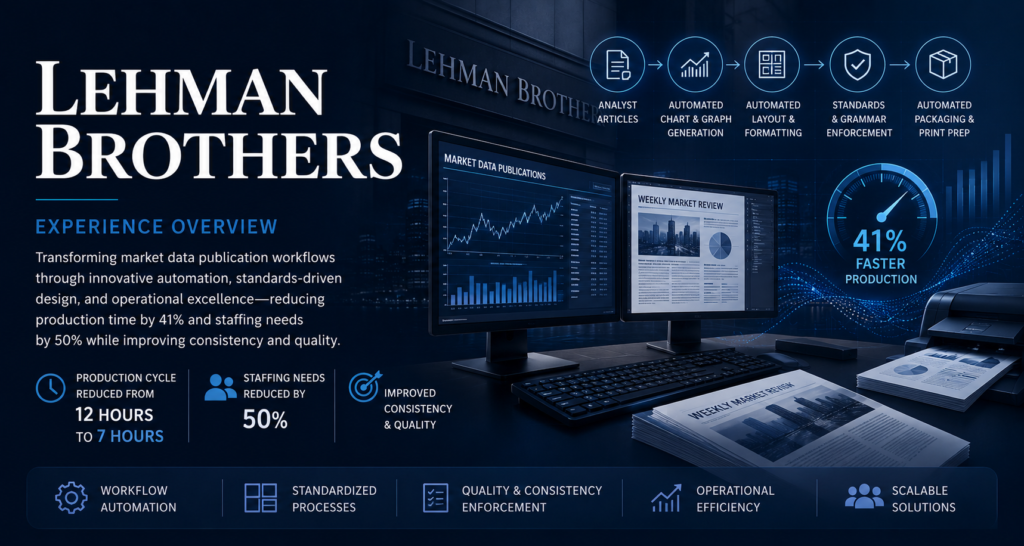
At Lehman Brothers, I supported the Market Data Publications Graphic Design department during a period of highly time-sensitive publication production operations tied directly to weekly market close reporting cycles.
What initially began as a production-oriented graphic design role rapidly evolved into a workflow automation and operational transformation initiative after I identified significant opportunities to improve publication consistency, operational efficiency, production scalability, and execution speed through automation and standardized workflow design.
Working independently during operational downtime between production cycles, I researched, designed, and developed a series of internally deployed automation tools that transformed the department’s graph generation, publication layout, formatting enforcement, and print packaging workflows.
The initiative ultimately reduced Friday production cycles from approximately twelve hours to seven while simultaneously improving consistency, reducing operational overhead, and cutting departmental staffing requirements by approximately fifty percent.
Although the work predated modern AI and Robotic Process Automation terminology, the initiative represented an early operational implementation of algorithm-driven workflow automation, standards enforcement, and intelligent production orchestration.
Graphic Design RPA
Graphic Design Workflow Automation & Operational Transformation
I originally joined Lehman Brothers as auxiliary support for the Market Data Publications Graphic Design department, assisting with highly compressed Friday evening production cycles tied to post-market publication deadlines.
The operational workflow involved:
- receiving analyst-written articles,
- generating supporting charts and graphs,
- formatting publication layouts,
- enforcing editorial standards,
- processing revisions,
- and packaging completed publications for external printing vendors.
After only a short period working within the environment, I recognized that much of the production effort consisted of repetitive manual processes being executed inconsistently across multiple designers. I also realized that the department’s editorial standards and style guides already contained the operational rules necessary to automate significant portions of the workflow.
Using available downtime during the week, I independently researched and developed a series of automation tools designed to:
- automate graph and chart creation,
- standardize publication formatting,
- enforce editorial layout and grammar rules,
- accelerate production workflows,
- and automate packaging preparation for printers.
The initiative was entirely self-conceived and developed without formal assignment or organizational direction. After demonstrating significantly accelerated production turnaround times, I shared the internally developed tools with department leadership and ultimately deployed the platform more broadly across the organization following creation of supporting user documentation.
Within approximately six months, the initiative substantially transformed departmental operations:
- Friday production cycles were reduced from approximately twelve hours to seven,
- publication consistency improved,
- operational overhead was reduced,
- and staffing requirements were reduced by approximately fifty percent.
The remaining production bottleneck was no longer internal operational execution, but rather the fixed submission window associated with analyst article delivery schedules.
Although developed well before modern enterprise AI and workflow automation platforms became mainstream, the initiative reflected many of the same foundational concepts now associated with:
- Robotic Process Automation (RPA),
- operational workflow orchestration,
- standards-based automation,
- algorithmic process execution,
- and intelligent operational optimization.
Key Focus Areas
- Workflow Automation
- Graphic Design RPA
- Operational Transformation
- Standards Enforcement
- Publication Workflow Optimization
- Algorithmic Automation
- Production Efficiency
- Process Standardization
Operational Themes
My experience at Lehman Brothers established several foundational professional themes that would continue throughout my later career:
- systems thinking,
- operational workflow analysis,
- automation-driven process improvement,
- standards-based execution,
- and scalable operational optimization.
The initiative also represented an early demonstration of a recurring professional pattern:
identifying operational inefficiencies within complex environments, designing structured workflow solutions, and leveraging automation to improve consistency, visibility, scalability, and execution performance.
Ready to Transform
Let’s discuss how tailored technology leadership can drive your enterprise forward.