
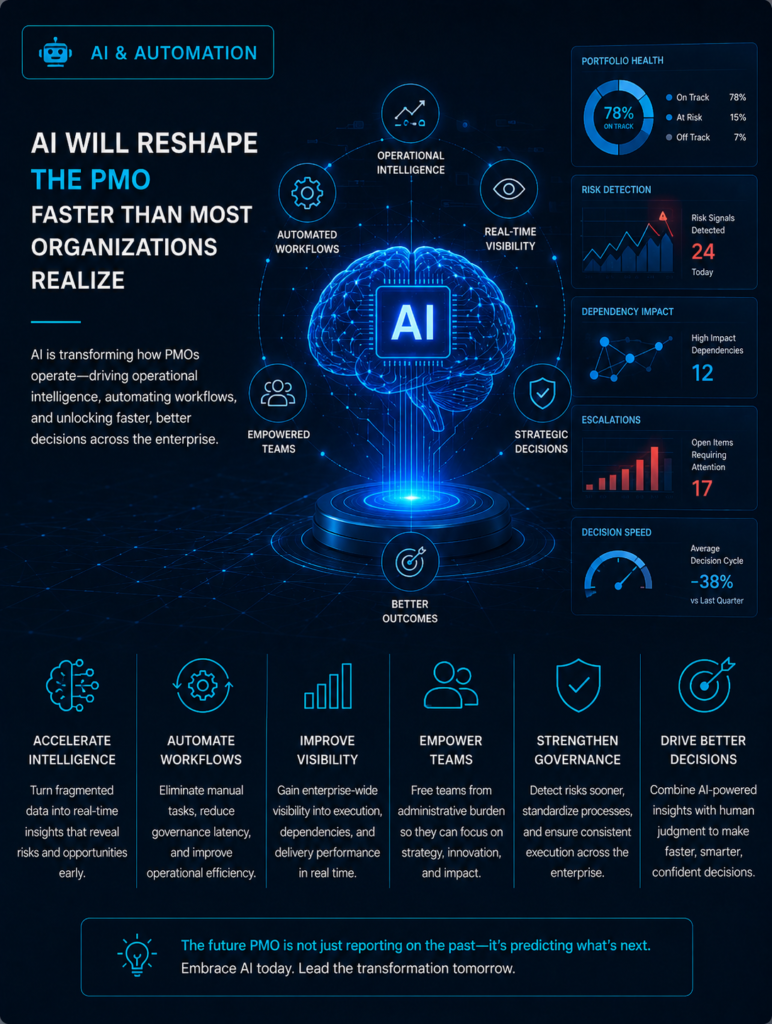
Most organizations still view AI as a future initiative.
The reality is that AI is already beginning to reshape enterprise delivery operations, governance workflows, reporting systems, operational intelligence, and decision-making structures inside the PMO.
The shift will happen faster than most organizations expect—not because AI replaces project managers, but because it fundamentally changes how information moves through the enterprise.
The PMO has historically been constrained by manual coordination:
- Manual reporting
- Manual status collection
- Manual governance preparation
- Manual reconciliation
- Manual communication workflows
- Manual risk aggregation
- Manual operational analysis
These activities consume enormous amounts of organizational energy while producing delayed visibility and inconsistent execution intelligence.
AI changes that equation.
The PMO Is Becoming an Intelligence Function
Traditional PMOs primarily serve as coordination and reporting bodies.
Next-generation PMOs will evolve into operational intelligence organizations.
The distinction matters.
A reporting-centric PMO tells leadership what happened.
An intelligence-centric PMO helps leadership understand:
- What is happening now
- What is changing
- What risks are emerging
- Where execution friction exists
- Which dependencies are destabilizing delivery
- Which operational signals require intervention
- Which decisions should be prioritized
AI dramatically accelerates the transition from historical reporting to real-time operational visibility.
Organizations that recognize this early will gain significant execution advantages.
Organizations that delay adaptation will find themselves overwhelmed by delivery complexity, governance latency, and information fragmentation.
AI Will Not Replace Strong PMOs — It Will Expose Weak Ones
There is a misconception that AI will eliminate PMO functions.
What AI will actually do is expose inefficient operating models.
PMOs heavily dependent on:
- Manual spreadsheet consolidation
- Static reporting
- Human-driven status collection
- Siloed governance processes
- Disconnected operational data
- Delayed escalation workflows
will struggle as enterprise delivery speed accelerates.
Meanwhile, operationally mature PMOs will use AI to amplify execution capability.
AI allows organizations to reduce friction across enterprise delivery ecosystems by:
- Automating information aggregation
- Identifying execution anomalies
- Detecting dependency conflicts
- Surfacing governance gaps
- Accelerating reporting cycles
- Improving operational consistency
- Reducing manual coordination overhead
- Increasing visibility across programs and portfolios
The result is not fewer decisions.
The result is better decisions made earlier.
The Real Opportunity Is Operational Intelligence
The greatest value of AI inside the PMO is not content generation.
It is operational intelligence.
Most organizations underestimate this distinction.
Generating meeting notes or drafting status updates provides marginal efficiency improvements.
The transformative value comes from creating interconnected intelligence systems capable of continuously analyzing enterprise execution signals.
This includes:
- Portfolio performance data
- Financial variance data
- Resource allocation trends
- Dependency mapping
- Governance workflows
- Risk escalation patterns
- Delivery velocity metrics
- Operational bottlenecks
- Application lifecycle signals
- Infrastructure readiness indicators
AI becomes exponentially more valuable when connected to operational systems rather than isolated chat interfaces.
The future PMO will increasingly resemble an enterprise intelligence hub rather than a traditional reporting organization.
Governance Will Change Dramatically
Governance itself will evolve under AI acceleration.
Traditional governance models were designed for slower operational environments where reporting cycles occurred weekly or monthly.
Modern enterprises operate too quickly for delayed governance structures.
AI enables governance models that are:
- Continuous rather than periodic
- Exception-driven rather than manually reviewed
- Predictive rather than reactive
- Operationally integrated rather than administratively isolated
This does not eliminate governance discipline.
It strengthens it.
The organizations that succeed will be those that combine:
- AI-enabled operational visibility
- Strong execution frameworks
- Clear accountability structures
- Data integrity
- Systems thinking
- Human leadership judgment
AI without governance creates noise.
Governance without intelligence creates latency.
The future enterprise requires both.
The Human Element Becomes More Important — Not Less
Ironically, AI increases the importance of leadership judgment.
As information velocity increases, organizations will need leaders capable of:
- Interpreting operational signals
- Understanding enterprise interdependencies
- Prioritizing conflicting objectives
- Managing organizational complexity
- Making strategic decisions under uncertainty
AI can surface patterns.
It cannot replace executive reasoning, organizational trust, stakeholder alignment, or strategic leadership.
The PMO leaders who thrive in the next decade will not simply manage schedules.
They will orchestrate intelligence.
The Organizations That Adapt Early Will Compound Advantages
The transition has already started.
Many organizations simply have not recognized it yet.
The enterprises that move early toward AI-enabled operational intelligence will compound advantages in:
- Delivery speed
- Governance quality
- Execution visibility
- Decision-making
- Resource optimization
- Risk management
- Organizational scalability
The PMO is no longer evolving incrementally.
It is entering structural transformation.
And the pace of that transformation will likely exceed what most organizations currently expect.