
Executive Summary
Personal Operating Environment (POE) Backup Orchestrator
Demonstrating governed AI-assisted engineering through a production-grade implementation
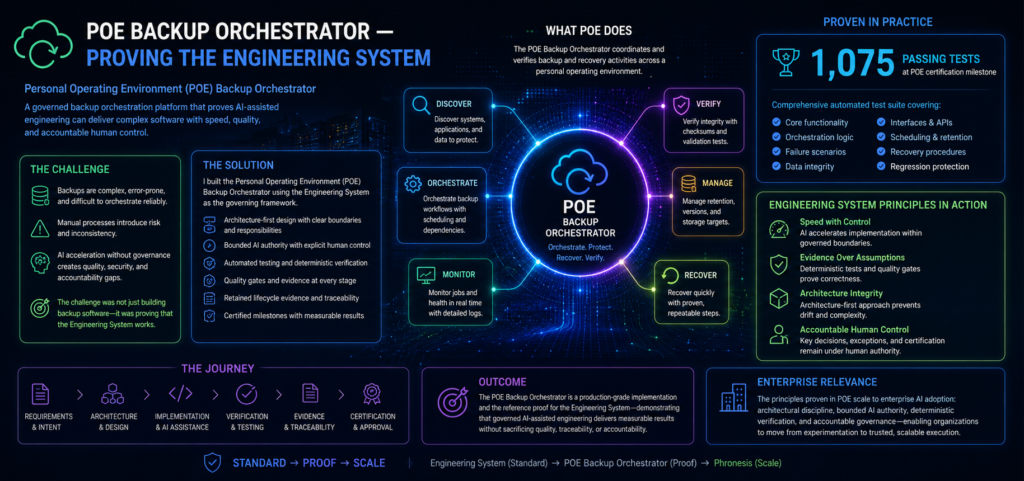
The Personal Operating Environment (POE) Backup Orchestrator was developed as a substantial software implementation governed by the Engineering System—providing practical evidence that AI-assisted development can accelerate delivery while maintaining architectural discipline, deterministic verification, traceability, and accountable human control.
Rather than treating AI as an unrestricted code-generation tool, the project applied explicit architecture, requirements, authority boundaries, verification gates, retained evidence, and certification criteria throughout the development lifecycle.
The result is both a functioning orchestration platform and a proof point for the Engineering System itself.
The Challenge
AI-assisted software development can dramatically increase implementation velocity, but velocity creates a corresponding governance problem.
As AI assumes more implementation work, traditional development controls can become increasingly difficult to apply consistently. Code may be produced faster than it can be reviewed, architectural intent can drift, assumptions can become embedded without adequate scrutiny, and apparent functionality can be mistaken for verified correctness.
The POE Backup Orchestrator provided a practical environment in which to address a fundamental question:
Can AI materially accelerate software engineering while preserving architecture, quality, evidence, traceability, and human accountability?
The objective was not simply to build backup software. It was to prove that a governed human/AI engineering model could successfully develop and certify a substantial software implementation.
The Solution
I designed and developed the Personal Operating Environment (POE) Backup Orchestrator using the Engineering System as the governing development framework.
The platform orchestrates backup and recovery activities across a personal technology environment while separating orchestration logic from underlying backup mechanisms. Its development required architecture, implementation, testing, lifecycle management, failure handling, evidence generation, and certification—the characteristics needed to meaningfully exercise the Engineering System rather than merely demonstrate it conceptually.
Development followed several governing principles:
Architecture before implementation.
System structure, component responsibilities, interfaces, and boundaries were established before implementation proceeded.
Bounded AI authority.
AI accelerated analysis, implementation, testing, documentation, and problem solving within defined authority boundaries rather than operating as an autonomous engineering authority.
Deterministic verification.
Claims of correctness were supported through automated testing and objective verification rather than relying solely on AI-generated assessments or subjective review.
Retained lifecycle evidence.
Development decisions, tests, verification results, and certification evidence were retained so that the state of the system could be reconstructed and evaluated.
Human accountability.
Architecture, acceptance criteria, exceptions, risk decisions, and certification remained under human authority.
From AI-Generated Code to Governed Engineering
The distinction proved important.
AI could generate code rapidly, but code generation alone did not establish that the system was architecturally correct, complete, safe, maintainable, or ready for certification.
The Engineering System therefore treated AI-generated implementation as an input to an engineering lifecycle—not as its final product.
The lifecycle created a controlled progression:
Intent → Architecture → Implementation → Verification → Evidence → Certification
Each stage constrained and validated the next. This enabled AI to contribute substantial implementation velocity while preserving the controls required to determine whether the resulting software actually satisfied its intended requirements.
Verification and Certification
Testing became one of the strongest mechanisms for separating apparent progress from demonstrated progress.
The POE Backup Orchestrator accumulated a broad automated test suite covering system behavior, orchestration logic, interfaces, failure conditions, regression protection, and architectural expectations.
At its documented POE certification milestone, the platform achieved:
1,075 Passing Tests
The significance of that number is not simply test volume.
The test suite became part of the Engineering System’s evidence model: an objective mechanism for demonstrating that implementation changes continued to satisfy established requirements and did not silently compromise previously verified behavior.
Certification therefore represented an evidence-backed engineering decision rather than a declaration that development appeared complete.
What the Implementation Proved
The POE Backup Orchestrator demonstrated that governed AI-assisted development can combine capabilities that are sometimes treated as competing objectives:
Speed with control.
AI can materially accelerate implementation without being granted unrestricted engineering authority.
Automation with accountability.
Large portions of engineering activity can be automated while key decisions remain explicitly attributable to human authority.
Iteration with architectural discipline.
Rapid development does not require abandoning architecture-first engineering.
AI assistance with deterministic proof.
AI-generated work can be evaluated through conventional, repeatable engineering mechanisms rather than relying upon the AI to validate itself.
Continuous improvement with controlled baselines.
A system can continue evolving while maintaining identifiable, tested, and certifiable states.
Outcome
The Personal Operating Environment Backup Orchestrator became more than the application it was originally intended to be.
It became the reference implementation for the Engineering System.
The project demonstrated that the Engineering System’s principles could govern a substantial implementation through architecture, development, verification, evidence collection, and certification. It provided practical evidence that AI-assisted software engineering can move beyond experimentation toward a disciplined operating model capable of supporting increasingly complex development.
The experience also informed the next stage of the work: applying the Engineering System’s principles beyond an individual implementation and into broader operational-intelligence and enterprise-AI architecture.
Enterprise Relevance
The POE Backup Orchestrator is intentionally a controlled implementation rather than an enterprise deployment. Its significance lies in what the implementation demonstrates.
Organizations adopting generative AI for software engineering face the same fundamental challenge at much greater scale: how to capture AI’s productivity advantage without weakening architecture, governance, quality assurance, traceability, or human accountability.
The POE implementation provides a working example of one answer:
AI acceleration should occur inside the engineering control system—not replace it.
That principle is directly applicable to enterprise AI adoption, governed software-development environments, AI-enabled SDLC modernization, engineering productivity programs, and organizations establishing controls for increasingly agentic development capabilities.