
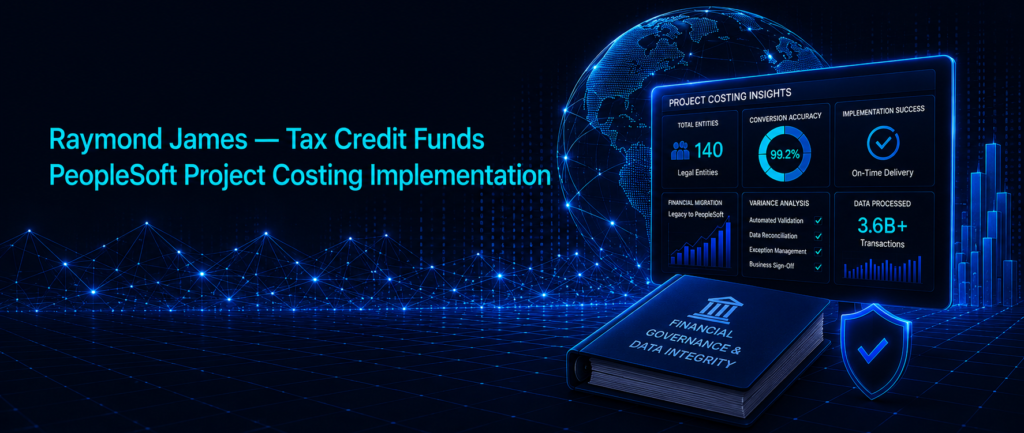
Executive Summary
As part of a major Raymond James PeopleSoft modernization initiative, I was brought in to lead the recovery and implementation of the PeopleSoft Project Costing solution supporting the Tax Credit Funds (TCF) organization — one of the most operationally and financially complex business areas within the deployment.
The implementation involved replacing highly customized legacy accounting and project tracking processes with a standardized enterprise PeopleSoft framework while simultaneously supporting a large-scale general ledger and subledger migration across approximately 150 legal entities.
After evaluating the existing implementation effort, I determined that the project required substantial restructuring. Working directly with multiple business organizations, I redefined project scope, rebuilt the implementation strategy, established governance and reporting processes, assembled additional project resources, and designed a parallel financial validation and reporting framework that enabled the business to manage aggressive deployment timelines while significantly reducing operational risk.
The resulting solution provided enterprise reporting visibility, streamlined conversion validation, improved financial governance, accelerated business decision-making, and enabled successful implementation delivery without requiring additional operational headcount.
Business Context
In 2016, Raymond James initiated a large-scale PeopleSoft modernization program involving a “Big Bang” implementation approach across multiple operational and financial business areas.
The deployment included:
- PeopleSoft Purchasing,
- PeopleSoft Accounts Payable,
- PeopleSoft Asset Management,
- PeopleSoft Project Costing,
- Accounting Hub,
- and other related financial systems modernization components.
The Tax Credit Funds organization represented one of the most complex implementation areas within the initiative due to:
- highly customized accounting structures,
- extensive legal entity requirements,
- complex subledger-to-general ledger relationships,
- and large-scale data conversion dependencies.
Historically, TCF operated using a sophisticated “smart coding” accounting structure embedded within the legacy general ledger platform. Approximately 140 legal entities relied upon this structure to support operational accounting and reporting activities.
The modernization initiative required migration away from these highly customized structures toward a standardized Raymond James enterprise chart of accounts model while preserving TCF-specific operational reporting capabilities and maintaining aggressive enterprise deployment schedules.
Operational Challenge
The project faced substantial operational and implementation challenges from the outset.
After joining the initiative, I evaluated the existing implementation effort and determined that the previously defined requirements, scope, and delivery approach were insufficient to support successful execution across the participating business groups.
The implementation involved four distinct client organizations whose operational complexity varied significantly:
- Events Planning,
- Construction & Building Operations,
- Technology,
- and Tax Credit Funds.
While some implementations were relatively straightforward, the Tax Credit Funds deployment introduced substantial complexity associated with:
- legacy accounting conversion,
- subledger mapping,
- financial reporting continuity,
- data validation,
- and operational governance.
One of the most significant challenges involved validating the accuracy of large-scale financial data conversions while operating under aggressive enterprise deployment timelines.
The business lacked an efficient mechanism for validating:
- staging data,
- general ledger mappings,
- subledger conversions,
- and project costing integrations
across hundreds of legal entities and large volumes of migrated financial data.
Traditional manual validation methods were operationally unrealistic given the scale and timeline constraints associated with the deployment.
Transformation Opportunity
Rather than approaching the initiative strictly as a software implementation, I viewed the project as a broader operational transformation and financial governance challenge.
The opportunity extended beyond deploying PeopleSoft functionality. It required:
- restructuring implementation governance,
- redefining operational workflows,
- improving financial visibility,
- accelerating business validation processes,
- and reducing implementation risk through operational intelligence and automation.
After evaluating the available resources and delivery timelines, I determined that the project required:
- revised implementation strategy,
- enhanced reporting capabilities,
- stronger operational coordination,
- and improved business decision support.
This ultimately led to the development of a parallel financial validation and operational reporting framework capable of supporting large-scale conversion analysis and executive decision-making throughout the implementation lifecycle.
Solution Development
Following my assessment of the implementation effort, I effectively restarted significant portions of the project planning process by working directly with the participating client groups to redefine:
- business requirements,
- implementation scope,
- conversion strategy,
- and operational priorities.
To support delivery execution, I worked to assemble additional project resources and establish more effective coordination between business, accounting, and technology teams.
Within the Tax Credit Funds organization, I worked closely with business stakeholders to define a revised accounting and reporting strategy that:
- preserved TCF-specific reporting requirements,
- aligned with Raymond James’ enterprise accounting standards,
- and supported migration to the standardized chart of accounts structure.
Recognizing that manual conversion validation was operationally unsustainable, I designed and developed a parallel reporting and reconciliation framework leveraging:
- conversion mapping logic maintained within SharePoint,
- legacy general ledger data,
- PeopleSoft staging tables,
- general ledger structures,
- and project costing subledger data.
The solution consolidated the information into a multidimensional reporting cube capable of supporting:
- variance analysis,
- conversion validation,
- reconciliation review,
- ledger reclassification analysis,
- and business sign-off workflows.
By automating large portions of the reporting and validation process, the framework enabled business stakeholders to focus attention on only the areas requiring investigation rather than manually reviewing entire conversion populations.
Leadership & Execution
The implementation required coordination across:
- Accounting,
- Tax,
- Technology,
- Operations,
- Project Management,
- and multiple client business organizations.
My role extended beyond traditional project management and included:
- implementation recovery,
- operational process redesign,
- reporting framework architecture,
- financial governance strategy,
- business analysis,
- stakeholder coordination,
- and delivery execution leadership.
The project also required balancing aggressive enterprise deployment deadlines against significant operational complexity and resource constraints.
A key element of the engagement involved establishing operational structure and execution discipline within an implementation environment initially struggling with scope definition, governance alignment, and delivery coordination.
Operational Outcomes
The implementation and supporting reporting framework delivered substantial operational and governance improvements, including:
- successful migration support across approximately 150 legal entities,
- improved financial conversion visibility,
- accelerated reconciliation and validation processes,
- reduced manual reporting effort,
- improved stakeholder decision-making,
- strengthened financial governance,
- and improved implementation execution control.
The multidimensional reporting and variance analysis framework enabled business users to rapidly identify conversion discrepancies, focus remediation efforts efficiently, and support sign-off activities within highly compressed implementation timelines.
Most significantly, the reporting automation and operational intelligence capabilities enabled the organization to achieve implementation objectives without requiring additional operational headcount despite the scale and complexity of the conversion effort.
Strategic Insight
This initiative reinforced the principle that enterprise implementations succeed or fail based largely on operational visibility, governance structure, and execution intelligence rather than software deployment alone.
Large-scale financial transformations require:
- integrated reporting,
- operational transparency,
- automated validation,
- and structured decision support
to effectively manage organizational complexity and implementation risk.
The project also demonstrated how operational intelligence and reporting automation can dramatically improve enterprise execution by reducing manual analysis overhead and enabling organizations to focus attention on actionable exceptions rather than raw data review.
Long before modern enterprise analytics and operational intelligence platforms became mainstream, this initiative represented an early example of combining systems integration, automated reporting, multidimensional analysis, and workflow-driven governance to support large-scale financial transformation execution.