
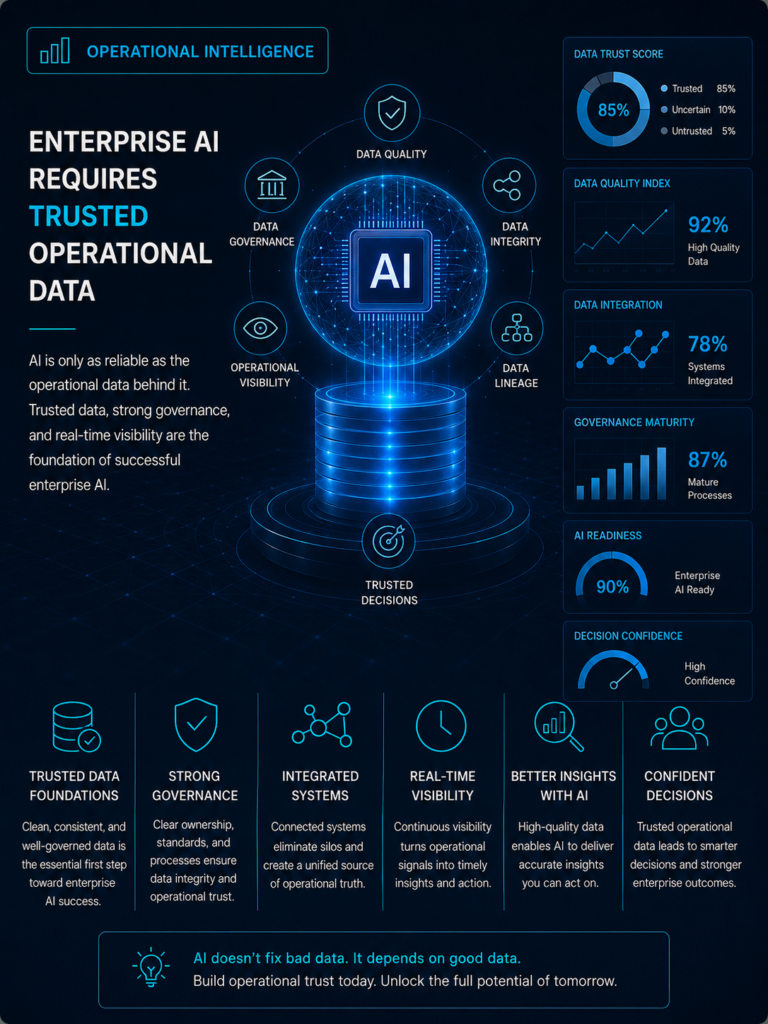
Artificial intelligence is rapidly becoming embedded into enterprise operations, governance, reporting, automation, and decision-making. Yet many organizations are approaching AI implementation with a dangerous assumption: that AI can compensate for weak operational data foundations.
It cannot.
AI does not eliminate operational complexity. In many cases, it amplifies it.
The effectiveness of enterprise AI is directly dependent on the quality, consistency, accessibility, and trustworthiness of the operational data feeding it. Organizations with fragmented systems, inconsistent governance, disconnected reporting, manual reconciliation, and unreliable execution metrics often discover that AI simply accelerates confusion instead of improving intelligence.
The issue is not the AI model itself.
The issue is operational trust.
AI Is Only As Reliable As The Operational Environment Supporting It
Most enterprise environments contain significant operational friction:
- Data spread across disconnected systems
- Inconsistent definitions and ownership
- Manual reporting processes
- Governance latency
- Delayed status visibility
- Unstructured execution data
- Conflicting metrics across teams
- Incomplete dependency mapping
- Limited operational lineage
When AI is introduced into these environments, it inherits those weaknesses.
If operational data is incomplete, AI recommendations become incomplete.
If governance data is inaccurate, AI-driven decisions become risky.
If execution visibility is delayed, AI insights arrive too late to matter.
Artificial intelligence cannot establish operational truth where operational discipline does not already exist.
Reporting Systems Were Not Designed For AI Consumption
Many organizations still rely on reporting structures originally designed for human interpretation rather than machine-driven analysis.
Traditional enterprise reporting often includes:
- Static dashboards
- Weekly status reports
- Manual spreadsheet consolidation
- Presentation-driven metrics
- Inconsistent project updates
- Narrative-based governance reporting
- Delayed financial reconciliation
- Human interpretation layers
These approaches may support executive visibility at a high level, but they do not create operational environments suitable for enterprise AI.
AI requires:
- Structured operational data
- Consistent metadata
- Real-time or near-real-time visibility
- Reliable process telemetry
- Standardized execution patterns
- Traceable governance workflows
- High-confidence operational lineage
Without these foundations, AI systems struggle to distinguish signal from noise.
Trusted Operational Data Is A Governance Problem
Organizations often frame AI readiness as a technology challenge.
In reality, it is largely a governance challenge.
Trusted operational intelligence requires:
- Clear ownership
- Standardized processes
- Consistent operational definitions
- Integrated workflows
- Cross-functional visibility
- Execution accountability
- Reliable data stewardship
- Continuous validation mechanisms
This is why organizations with mature operational governance often adopt AI more successfully than organizations with larger technology budgets but fragmented execution environments.
AI maturity follows operational maturity.
Not the other way around.
Operational Intelligence Creates AI Readiness
Organizations preparing for enterprise AI should focus less on adding isolated AI tools and more on strengthening operational intelligence systems.
That includes:
Standardizing Execution Data
Create consistent operational structures across projects, portfolios, governance workflows, and reporting systems.
Eliminating Manual Consolidation
Reduce spreadsheet-driven reporting and disconnected status collection processes.
Integrating Operational Systems
Connect financial, governance, execution, delivery, and reporting data into unified operational frameworks.
Improving Data Lineage
Establish traceability across operational processes, approvals, dependencies, risks, and outcomes.
Building Real-Time Visibility
Shift from retrospective reporting toward continuous operational awareness.
Creating Trustworthy Metrics
Ensure enterprise KPIs are accurate, validated, explainable, and consistently interpreted.
These are not merely operational improvements.
They are foundational AI enablement activities.
The Future Enterprise Will Depend On Operational Trust
The organizations that benefit most from AI will not necessarily be the organizations deploying the most AI tools.
They will be the organizations with:
- The strongest operational discipline
- The clearest governance structures
- The most reliable execution telemetry
- The highest confidence operational data
- The best integrated enterprise visibility
In the coming years, operational trust will become one of the most important strategic assets in enterprise technology leadership.
Because AI does not replace operational intelligence.