
Executive Summary
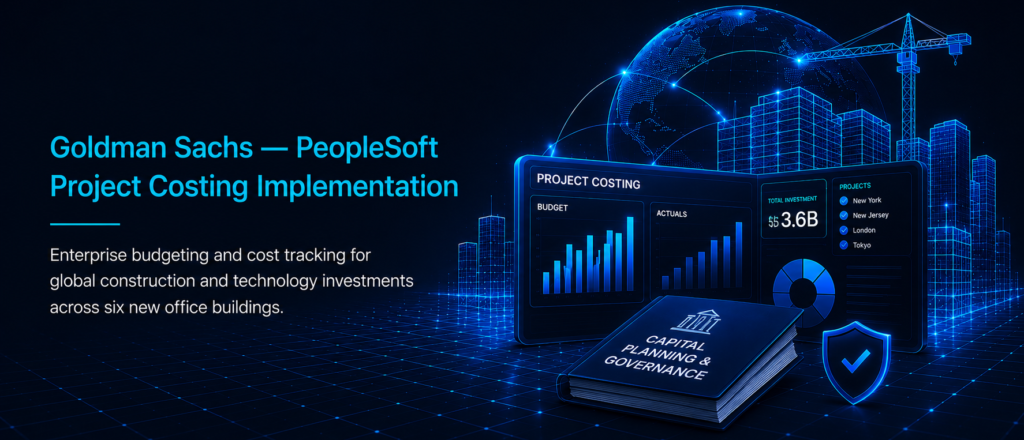
Following Goldman Sachs’ IPO, the Firm initiated a large-scale global expansion program involving the construction and technology enablement of major office facilities in New York, New Jersey, London, and Tokyo.
To support the initiative, the organization required an enterprise-capable solution for capital budgeting, project cost governance, operational forecasting, and financial tracking across both Design & Construction (D&C) and Technology organizations — two operational groups that historically operated independently with limited coordination.
Recognizing both the operational fragmentation and governance risks associated with the existing budgeting model, I designed and led the implementation of a global PeopleSoft Project Costing solution integrated with enterprise financial systems.
The initiative established standardized project budgeting, operational cost tracking, procurement integration, workflow coordination, and executive financial visibility across a multi-billion-dollar global capital program. Over the following six years, the solution supported the budgeting and tracking of more than USD 3.6 billion associated with the construction and technology deployment of six major international office facilities.
Business Context
In the period following Goldman Sachs’ transition to a publicly traded company, the Firm initiated an aggressive global expansion strategy involving the construction and technology enablement of new office facilities across multiple international locations.
The scale and complexity of the initiative introduced substantial operational and financial governance challenges. Capital planning, budgeting, purchasing, technology coordination, and project tracking activities were fragmented across multiple business units, regions, and operational teams.
At the time, both Design & Construction and Technology organizations maintained independent budgeting methodologies, operational practices, and supporting technologies. Cost estimation practices varied significantly by region and organizational group, limiting visibility into actual project performance and reducing confidence in enterprise capital forecasting.
Technology costs associated with construction initiatives were often estimated independently by D&C personnel using incomplete historical data and generalized square-footage run rates without direct coordination with Technology leadership or engineering resources.
As a privately held organization, operational accountability around project budgeting had historically been less formalized. However, following the IPO and the appointment of new executive leadership within Design & Construction, the Firm required significantly stronger financial governance, capital accountability, and enterprise reporting visibility.
Operational Challenge
The core challenge extended far beyond software implementation.
The organization lacked:
- standardized capital budgeting processes,
- integrated project cost governance,
- coordinated operational workflows,
- and enterprise-wide visibility into construction and technology expenditures.
The most significant operational obstacle involved the longstanding organizational disconnect between Design & Construction and Technology groups. Years of operational contention had created siloed budgeting practices, fragmented communication, and inconsistent collaboration between the organizations responsible for delivering highly interdependent components of global office development initiatives.
This fragmentation introduced several enterprise risks:
- inaccurate technology cost forecasting,
- inconsistent capital planning methodologies,
- limited project accountability,
- fragmented operational reporting,
- and insufficient executive visibility into project performance and budget adherence.
At the same time, the organization lacked a centralized enterprise platform capable of integrating:
- budgeting,
- procurement,
- Accounts Payable actuals,
- project tracking,
- and operational reporting
within a unified governance framework.
Transformation Opportunity
Having recently completed the PeopleSoft Purchasing implementation, I recognized an opportunity to leverage the Firm’s existing PeopleSoft investment to establish a standardized enterprise project costing and capital governance platform.
During initial research and stakeholder engagement activities, I discovered that Goldman Sachs had already licensed the PeopleSoft Project Costing module, although it remained unused within the organization.
The opportunity extended beyond simply implementing unused software functionality. It represented a broader enterprise transformation initiative focused on:
- standardizing global capital budgeting,
- improving operational coordination,
- integrating procurement and financial tracking,
- and establishing enterprise-level project governance.
Equally important, the initiative created an opportunity to improve collaboration and operational alignment between D&C and Technology organizations while introducing scalable financial controls and accountability structures.
Solution Development
Working closely with stakeholders across Design & Construction, Technology, Accounting, Purchasing, Accounts Payable, Asset Management, and operational leadership teams, I led the design and implementation of a globally integrated PeopleSoft Purchasing and Project Costing solution.
The implementation strategy focused on balancing organizational autonomy with structured collaboration.
To support this objective, I established operational workflows that:
- enabled coordinated budgeting activities between D&C and Technology,
- standardized project cost planning,
- integrated procurement workflows,
- and centralized project financial tracking within PeopleSoft.
One of the early operational improvements involved creating a structured handoff process allowing D&C project budgeting spreadsheets to be routed to Technology teams for review and refinement before loading into the PeopleSoft Project Costing platform.
Working collaboratively with representatives from both organizations, we also developed a globally coordinated annual capital budgeting schedule aligned to enterprise governance requirements.
Within three months, all global D&C operations were successfully onboarded to PeopleSoft Purchasing and Project Costing.
Following the initial implementation, I continued working with Technology resources to develop an intranet-based enterprise budgeting platform that supported:
- high-level capital budgeting,
- detailed operational budgeting,
- automated workflow routing,
- data collection,
- and approval management processes.
The solution established a scalable operational framework capable of supporting ongoing global capital planning and financial governance activities across the enterprise.
Leadership & Execution
The initiative required substantial cross-functional coordination across:
- Design & Construction,
- Technology,
- Accounting,
- Purchasing,
- Asset Management,
- Accounts Payable,
- and executive leadership teams.
My role extended beyond traditional project management and included:
- enterprise process design,
- operational workflow strategy,
- stakeholder alignment,
- governance development,
- systems integration planning,
- budgeting process transformation,
- and organizational relationship management.
A significant portion of the initiative involved rebuilding operational trust and collaboration between historically disconnected organizations while simultaneously implementing enterprise-scale governance modernization.
Over the following six years, I managed and coordinated hundreds of operational, accounting, technology, purchasing, and project resources supporting global construction and technology initiatives.
Operational Outcomes
The implementation fundamentally transformed capital budgeting and project cost governance across Goldman Sachs’ global Design & Construction and Technology organizations.
Key operational outcomes included:
- standardized global capital budgeting processes,
- improved project cost visibility,
- integrated procurement and financial tracking,
- enhanced executive reporting and governance,
- improved collaboration between D&C and Technology organizations,
- centralized operational forecasting,
- and improved accountability for project financial performance.
The solution ultimately supported the budgeting and tracking of more than USD 3.6 billion associated with the construction and technology deployment of six major office facilities across New York, New Jersey, London, and Tokyo.
The initiative also established a scalable operational governance framework capable of supporting continued enterprise growth and large-scale global capital planning activities.
Strategic Insight
This initiative reinforced the principle that enterprise transformation challenges are often fundamentally organizational and operational rather than purely technical.
While the PeopleSoft platform provided the technological foundation, the true transformation involved:
- establishing operational alignment,
- standardizing governance,
- improving collaboration,
- and embedding financial visibility into enterprise execution processes.
The project also demonstrated the importance of integrating budgeting, procurement, operational workflows, and financial tracking into unified governance ecosystems capable of supporting enterprise-scale decision-making.
Long before modern operational intelligence platforms became mainstream, this initiative represented an early example of integrating enterprise systems, workflow coordination, financial governance, and operational visibility into a scalable transformation framework supporting global business operations.