
Executive Summary
During a broader enterprise modernization initiative involving the implementation of PeopleSoft Purchasing and Project Costing systems at Goldman Sachs, I identified a significant operational and financial controls risk associated with the Firm’s planned rollout of the Ariba web requisitioning platform.
The initiative decentralized purchasing activities by shifting requisition creation directly to business users across the organization. Having worked closely with both the Purchasing and accounting functions during the PeopleSoft implementation, I recognized that the transition would likely introduce substantial accounting inconsistencies, downstream Accounts Payable processing issues, and financial governance challenges if accounting classifications were left entirely to end users.
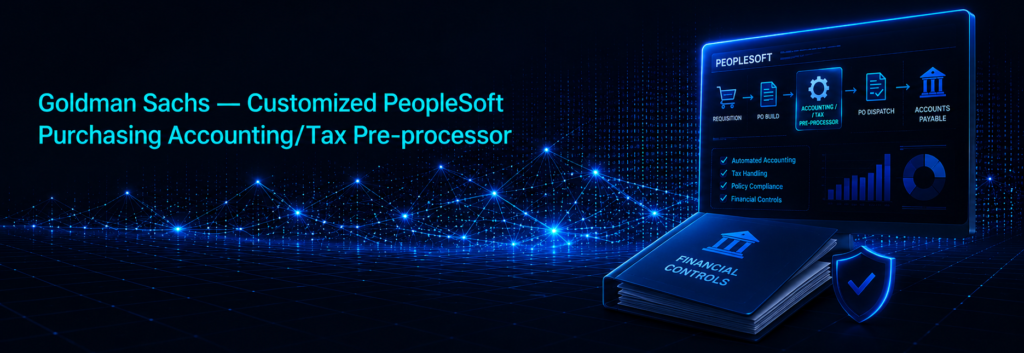
What initially began as an effort to improve operational visibility through exception reporting evolved into the design and implementation of a globally deployed automated accounting and tax processing solution integrated directly into the PeopleSoft Purchasing workflow.
The resulting enhancement automated accounting classification, standardized purchasing controls, improved financial consistency, reduced manual intervention, strengthened operational governance, and ultimately transformed enterprise purchasing processes across the Firm.
Business Context
As part of a broader enterprise systems modernization effort, Goldman Sachs implemented the Ariba web requisitioning platform to decentralize purchasing activities and improve procurement scalability across the organization.
Historically, purchasing activities had been heavily supported by centralized Purchasing Department buyers who worked closely with accounting and asset management teams to ensure transactions were coded appropriately and aligned with the Firm’s accounting policies and financial controls.
The planned decentralization of purchasing workflows introduced significant operational complexity. Business users across the organization would now be responsible for initiating purchasing activity directly, increasing the likelihood of:
- inconsistent accounting treatment,
- incorrect general ledger classification,
- tax handling discrepancies,
- downstream reconciliation issues,
- and operational inefficiencies within Accounts Payable.
Because purchasing transactions ultimately flowed through enterprise financial systems, the quality and consistency of accounting data entering the process became critically important.
Operational Challenge
The primary operational concern centered around maintaining accounting integrity and financial governance within a decentralized purchasing environment.
Without centralized buyer oversight, the organization faced several emerging risks:
- inconsistent accounting decisions across business units,
- incorrect GL account assignments,
- increased Accounts Payable exception handling,
- inconsistent tax treatment,
- reduced financial reporting accuracy,
- and operational bottlenecks associated with manual transaction review.
Initially, I approached the challenge from a reporting and exception-management perspective, with the goal of helping Purchasing Department personnel identify only those transactions requiring manual review and correction.
However, while developing the SQL logic for the reporting process, it became increasingly clear that the operational bottleneck itself could potentially be eliminated through rules-based accounting automation.
Rather than merely identifying problematic transactions after submission, the process could proactively apply standardized accounting and tax logic directly within the purchasing workflow before downstream processing occurred.
Transformation Opportunity
The purchasing environment contained a significant amount of repeatable procedural logic driven by established accounting policies, purchasing rules, and tax treatment standards.
By collaborating directly with the Firm’s accountants and operational stakeholders, it became possible to translate institutional accounting knowledge into structured automation rules capable of:
- standardizing purchasing classifications,
- improving accounting consistency,
- automating transaction handling,
- and reducing downstream exception management.
The opportunity extended beyond simple workflow efficiency. It represented a broader operational transformation initiative focused on embedding governance, accounting intelligence, and standardized controls directly into enterprise procurement operations.
Solution Development
After developing an initial prototype and presenting the concept to management, the initiative was formally approved for implementation.
Working closely with the Firm’s accounting organization, I led the effort to:
- define accounting automation rules,
- document operational requirements,
- develop detailed business requirements documentation,
- and create logic-flow diagrams governing transaction processing behavior.
Following business sign-off, I collaborated with Goldman Sachs Technology Group to implement a customized PeopleSoft Purchasing enhancement that functioned as a bolt-on automation layer integrated between the PO Build and PO Dispatch processes.
The solution automatically evaluated purchasing transactions and applied standardized accounting and tax logic before transactions progressed through downstream financial processing workflows.
As the initiative matured, additional tax-handling functionality was incorporated into the process to support complex tax treatment requirements associated with major construction projects and negotiated tax agreements involving New York and New Jersey tax authorities.
Leadership & Execution
The initiative required close coordination across:
- Purchasing,
- Accounting,
- Asset Management,
- Technology,
- and operational leadership teams.
My role extended beyond traditional project coordination and included:
- operational process analysis,
- workflow redesign,
- requirements development,
- automation strategy,
- accounting rules abstraction,
- stakeholder alignment,
- and implementation coordination.
The initiative originated not from a formal mandate, but from proactively identifying operational risk exposure during enterprise transformation activities and developing a scalable solution before the issues materialized at enterprise scale.
This required both technical fluency and operational systems thinking to bridge business process requirements with enterprise technology implementation.
Operational Outcomes
The automated accounting and tax pre-processing solution produced significant operational and governance improvements across the enterprise purchasing environment, including:
- improved accounting consistency across decentralized purchasing operations,
- reduced manual intervention and transaction correction,
- strengthened purchasing governance and financial controls,
- improved downstream Accounts Payable processing quality,
- standardized tax treatment handling,
- reduced operational bottlenecks,
- and improved scalability of procurement operations.
The solution proved so effective operationally that the Firm’s Lead Accountant ultimately mandated that all purchasing activity be processed through the PeopleSoft Purchasing system, effectively discontinuing the practice of directly paying vendor invoices through Accounts Payable without an approved purchase order workflow.
The solution also provided substantial continuity and operational consistency benefits during the later consolidation and globalization of purchasing operations into centralized offshore support structures characterized by high personnel turnover.
Strategic Insight
This initiative reinforced the principle that operational bottlenecks are often symptoms of deeper workflow and governance design challenges rather than isolated process inefficiencies.
Rather than relying solely on exception reporting and downstream correction activities, embedding standardized operational intelligence directly into enterprise workflows can significantly improve scalability, consistency, governance, and execution quality.
The project also demonstrated how institutional business knowledge — particularly accounting and operational decision-making logic — can be translated into structured automation frameworks capable of improving enterprise execution at global scale.
Long before AI-enabled operational automation became mainstream, this work represented an early example of embedding procedural intelligence and governance logic directly into enterprise business processes to improve operational efficiency, consistency, and organizational scalability.