
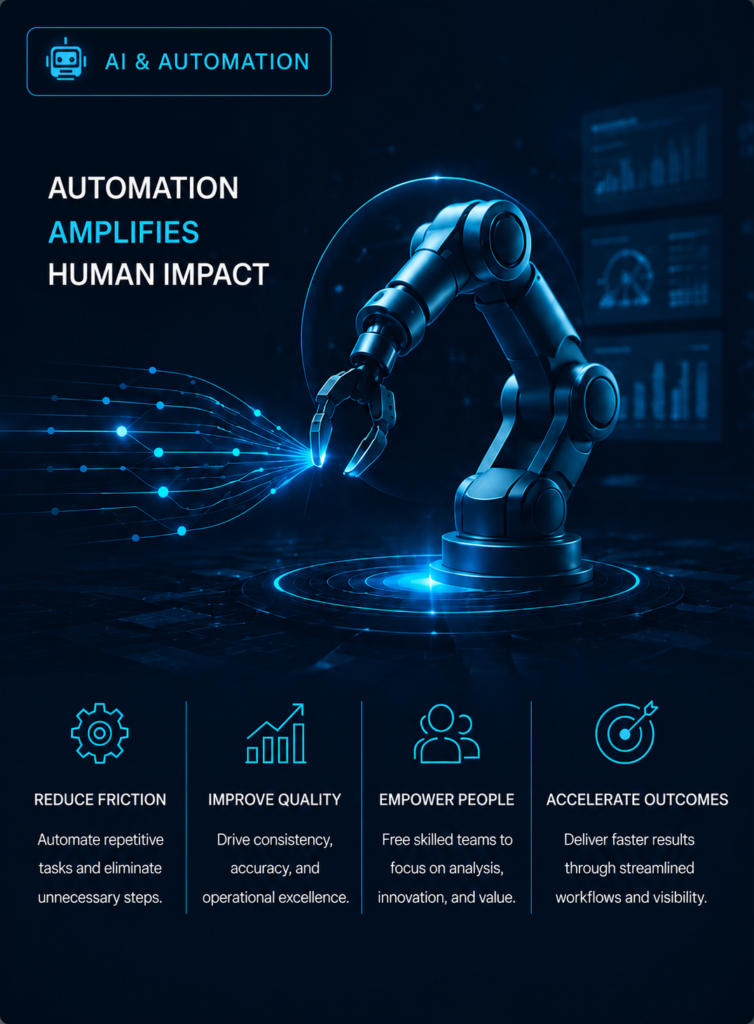
Automation is often misunderstood as a mechanism for reducing labor or eliminating human involvement. In practice, the most effective automation strategies are not focused on replacing expertise — they are focused on amplifying it.
The true value of automation lies in reducing operational friction, improving consistency, accelerating information flow, and allowing skilled professionals to focus on higher-value analytical, strategic, and decision-oriented work.
Most enterprise environments contain large volumes of repetitive operational activity:
- manual reporting,
- data gathering,
- status consolidation,
- workflow coordination,
- repetitive approvals,
- and administrative processing.
While individually small, these tasks consume substantial organizational capacity over time. More importantly, they often distract experienced professionals from work that creates significantly greater business value.
Well-designed automation shifts this balance.
When repetitive operational tasks are automated, organizations gain:
- improved execution consistency,
- faster operational visibility,
- reduced reporting latency,
- stronger governance support,
- and more efficient use of skilled human capital.
Automation should therefore be viewed as an operational enablement strategy rather than simply a cost-reduction initiative.
In enterprise delivery environments, automation becomes especially valuable when integrated into governance and operational intelligence frameworks. Automated reporting pipelines, workflow triggers, dashboard systems, status aggregation, and AI-assisted operational analysis can significantly improve visibility while reducing manual coordination overhead.
This creates an important organizational advantage: skilled teams spend less time assembling information and more time interpreting it.
The distinction matters.
Organizations rarely gain long-term advantage merely by automating isolated tasks. Sustainable improvement occurs when automation strengthens the overall operational system:
- improving transparency,
- accelerating feedback loops,
- reducing execution friction,
- and enabling faster, more informed decision-making.
This principle also applies to AI-enabled automation. AI should not be viewed solely as a replacement mechanism. Its greatest enterprise value often emerges when it augments operational intelligence, enhances analytical capability, improves workflow orchestration, and assists teams in managing increasingly complex execution environments.
As enterprise systems continue to grow in scale and complexity, organizations that successfully integrate automation into governance, reporting, workflow management, and operational intelligence frameworks will be better positioned to improve execution quality while enabling their highest-value contributors to focus on innovation, leadership, and strategic problem-solving.
The future of enterprise automation is not simply about doing more with fewer people. It is about enabling organizations to operate with greater intelligence, clarity, adaptability, and execution precision.