
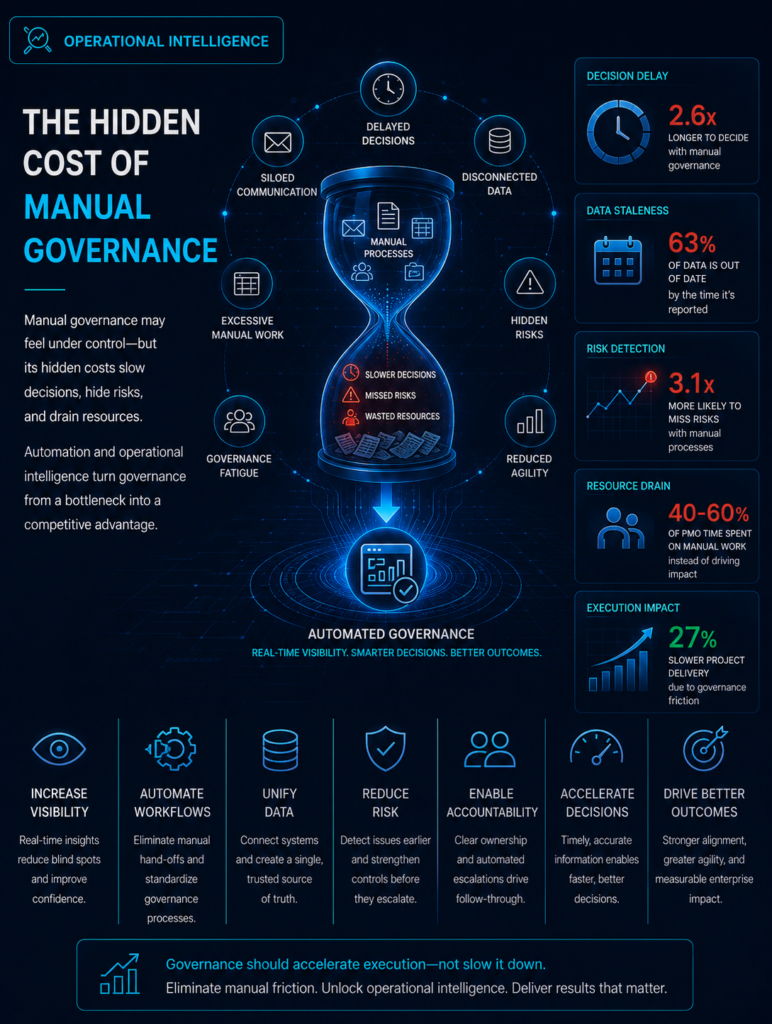
Most organizations believe their governance processes are functioning effectively because reports are being produced, meetings are occurring, approvals are documented, and status updates are being distributed.
From the outside, the structure appears operational.
But beneath the surface, many enterprise governance models are still heavily dependent on manual coordination, fragmented reporting, disconnected systems, spreadsheet consolidation, email-driven workflows, and delayed decision cycles.
The result is not simply inefficiency.
It is operational drag that quietly compounds across the enterprise.
Governance Often Creates Latency Instead of Visibility
Governance is intended to improve alignment, reduce risk, increase accountability, and support better decision-making.
But when governance processes rely on excessive manual effort, they frequently produce the opposite outcome.
Teams spend enormous amounts of time:
- Preparing status reports
- Reconciling inconsistent data
- Updating spreadsheets
- Consolidating metrics
- Chasing approvals
- Coordinating meetings
- Validating information manually
- Rebuilding presentations
- Tracking dependencies through email
- Maintaining disconnected reporting artifacts
Instead of improving operational visibility, manual governance often delays it.
By the time information reaches leadership, the operational reality may have already changed.
The Enterprise Rarely Measures Governance Friction
One of the biggest problems with manual governance is that organizations rarely quantify its true operational cost.
The visible costs are easy to identify:
- PMO staffing
- Reporting tools
- Governance meetings
- Administrative overhead
The hidden costs are much larger:
- Slower decisions
- Delayed escalations
- Reduced execution speed
- Governance fatigue
- Duplicated effort
- Data inconsistency
- Misaligned priorities
- Delayed risk visibility
- Reduced organizational agility
- Resource diversion away from high-value work
Over time, governance friction compounds into enterprise-wide execution inefficiency.
Organizations begin optimizing reporting activity instead of optimizing outcomes.
Manual Reporting Is Not Operational Intelligence
Many governance models are still built around periodic reporting cycles rather than real-time operational visibility.
This creates a fundamental problem.
Static reporting captures snapshots.
Operational intelligence monitors conditions continuously.
Traditional governance approaches often depend on manually assembled presentations generated weekly, monthly, or quarterly from fragmented systems that do not naturally integrate together.
This creates multiple points of failure:
- Data becomes stale
- Metrics lose context
- Dependencies remain hidden
- Risks surface late
- Escalations become reactive
- Decision-making slows
- Leadership visibility becomes fragmented
Operational intelligence requires connected systems, automated visibility, integrated reporting pipelines, and continuously updated execution insights.
Without that foundation, governance becomes reactive administration instead of proactive operational management.
Manual Governance Creates Human Bottlenecks
In many organizations, critical governance processes depend heavily on specific individuals who manually maintain operational visibility.
A single PMO analyst may become responsible for consolidating dozens of reports.
A project manager may spend more time updating status artifacts than managing delivery execution.
Leadership visibility may depend on manual interpretation rather than automated intelligence.
This creates fragile operational dependency chains.
When governance depends primarily on human consolidation effort:
- Scaling becomes difficult
- Consistency declines
- Errors increase
- Visibility becomes delayed
- Knowledge becomes siloed
- Institutional resiliency weakens
The organization becomes operationally dependent on administrative coordination instead of intelligent systems.
Automation Changes the Role of Governance
Automation does not eliminate governance.
It strengthens it.
The goal is not fewer controls.
The goal is better operational visibility with less friction.
Modern governance models should increasingly focus on:
- Automated data collection
- Real-time reporting
- Continuous risk visibility
- Workflow orchestration
- Intelligent escalation
- Dependency monitoring
- Operational analytics
- AI-assisted insights
- Exception-based management
- Cross-system integration
Instead of manually assembling information, governance teams should focus on interpreting intelligence, identifying emerging risk patterns, improving execution capability, and supporting strategic decision-making.
The PMO of the future will operate less like a reporting factory and more like an operational intelligence organization.
The Organizations That Adapt Will Move Faster
As enterprise complexity increases, organizations that continue relying on highly manual governance structures will struggle to maintain execution speed.
The enterprises that gain competitive advantage will be those capable of:
- Reducing governance latency
- Increasing operational visibility
- Automating administrative overhead
- Integrating fragmented systems
- Detecting risks earlier
- Accelerating decision-making
- Improving execution coordination
- Creating scalable operational intelligence
Governance should accelerate execution.
Not slow it down.
The hidden cost of manual governance is not simply inefficiency.
It is lost organizational capability.