
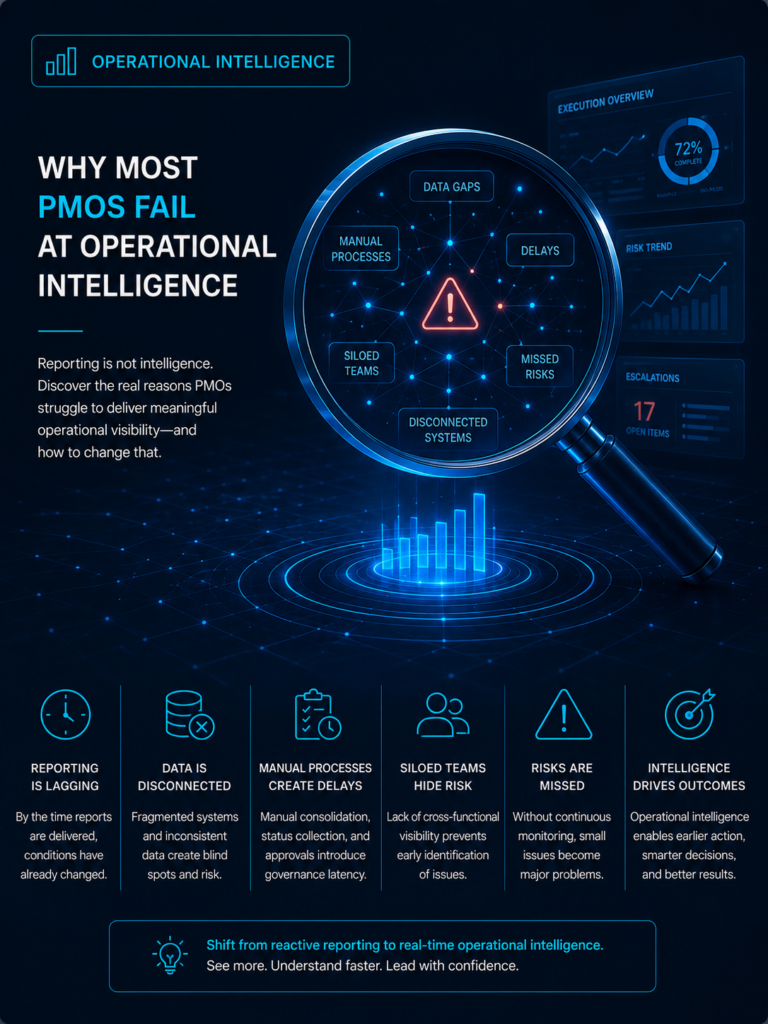
Most PMOs believe they have visibility into enterprise execution because they produce dashboards, status reports, steering updates, and governance artifacts. In reality, many organizations operate with fragmented operational awareness, delayed escalation cycles, inconsistent reporting fidelity, and limited insight into actual execution conditions.
The problem is not a lack of reporting.
The problem is the absence of operational intelligence.
Traditional PMO structures were designed around administrative coordination, governance workflows, and periodic reporting cycles. While those functions remain important, enterprise technology delivery has evolved into a highly interconnected operational ecosystem involving distributed teams, integrated platforms, cybersecurity dependencies, regulatory constraints, cloud services, vendor coordination, and rapidly shifting execution priorities.
In that environment, static reporting is no longer sufficient.
Organizations require systems capable of detecting operational variance early, surfacing execution risk continuously, identifying dependency pressure points, and providing leadership with meaningful situational awareness rather than retrospective summaries.
Reporting Is Not Operational Intelligence
Many PMOs unintentionally confuse reporting activity with operational visibility.
A project status report may indicate:
- schedule health,
- budget variance,
- milestone completion,
- resource allocation,
- or risk summaries.
But those indicators often represent delayed administrative abstractions rather than real execution telemetry.
Operational intelligence is fundamentally different.
Operational intelligence focuses on:
- execution flow,
- dependency interactions,
- delivery friction,
- escalation velocity,
- governance latency,
- operational bottlenecks,
- exception patterns,
- and systemic execution risk.
The distinction is critical.
A dashboard can appear “green” while operational conditions are actively deteriorating underneath the surface.
This occurs frequently when:
- reporting cycles lag behind execution realities,
- governance data is manually aggregated,
- teams normalize schedule pressure,
- dependencies are not continuously analyzed,
- or operational bottlenecks remain disconnected across platforms and organizations.
Without operational intelligence, leadership often receives visibility only after execution instability has already materialized.
Manual Governance Creates Operational Blind Spots
One of the most common failure patterns inside enterprise PMOs is excessive dependence on manual governance processes.
Examples include:
- manually assembled status reports,
- spreadsheet-based consolidation,
- disconnected portfolio data sources,
- inconsistent reporting standards,
- static steering committee presentations,
- delayed escalation workflows,
- and fragmented operational ownership.
These environments create governance latency.
By the time data is consolidated, validated, reviewed, reformatted, approved, and presented, the operational conditions may already be materially different from the information being discussed.
This produces:
- delayed decision-making,
- reactive leadership behavior,
- reduced execution agility,
- escalation fatigue,
- and governance structures that struggle to keep pace with enterprise delivery complexity.
As organizations scale, the problem compounds.
The larger and more interconnected the enterprise becomes, the less effective manual operational governance becomes.
Enterprise Delivery Is a Dynamic System
Technology delivery is not a sequence of isolated projects.
It is a living operational system.
Applications, infrastructure, security controls, cloud services, data pipelines, vendor integrations, reporting platforms, governance workflows, and business operations continuously influence one another.
This means execution risk rarely emerges from a single issue.
Most delivery instability originates from:
- dependency accumulation,
- operational friction,
- fragmented accountability,
- poor information flow,
- governance disconnects,
- or insufficient execution visibility across organizational boundaries.
PMOs that fail to recognize this systems dynamic often focus too heavily on:
- milestone tracking,
- administrative compliance,
- and presentation-oriented reporting.
Meanwhile, the actual operational environment continues evolving underneath them.
Operational intelligence shifts the focus from reporting activity to execution awareness.
Operational Intelligence Requires Automation
Modern PMOs cannot scale operational visibility through manual effort alone.
Enterprise operational intelligence increasingly depends on:
- workflow automation,
- integrated reporting pipelines,
- exception-based management,
- automated variance detection,
- cross-platform telemetry,
- operational analytics,
- and continuously refreshed execution data.
The objective is not to replace governance.
The objective is to strengthen governance by improving the quality, speed, consistency, and usability of operational information.
When implemented effectively, operational intelligence enables organizations to:
- identify risk earlier,
- reduce reporting friction,
- accelerate escalation workflows,
- improve stakeholder confidence,
- strengthen governance quality,
- and make decisions using near real-time operational conditions rather than static snapshots.
This becomes especially important during:
- enterprise modernization,
- financial systems conversions,
- cybersecurity transformation,
- AI enablement initiatives,
- cloud migrations,
- and large-scale operational restructuring efforts.
The Future PMO Will Operate Differently
The PMO is evolving from a reporting organization into an operational intelligence function.
Future enterprise delivery organizations will increasingly rely on:
- automated governance telemetry,
- AI-assisted operational analysis,
- intelligent escalation workflows,
- integrated execution visibility,
- and continuously evolving operational data models.
PMOs that continue operating primarily as administrative reporting coordinators will struggle to provide strategic value at enterprise scale.
PMOs that embrace operational intelligence will become central to:
- enterprise execution,
- transformation governance,
- delivery risk management,
- and organizational decision support.
The difference between those two outcomes is not tooling alone. It is whether the organization understands that visibility is not the same thing as intelligence.