
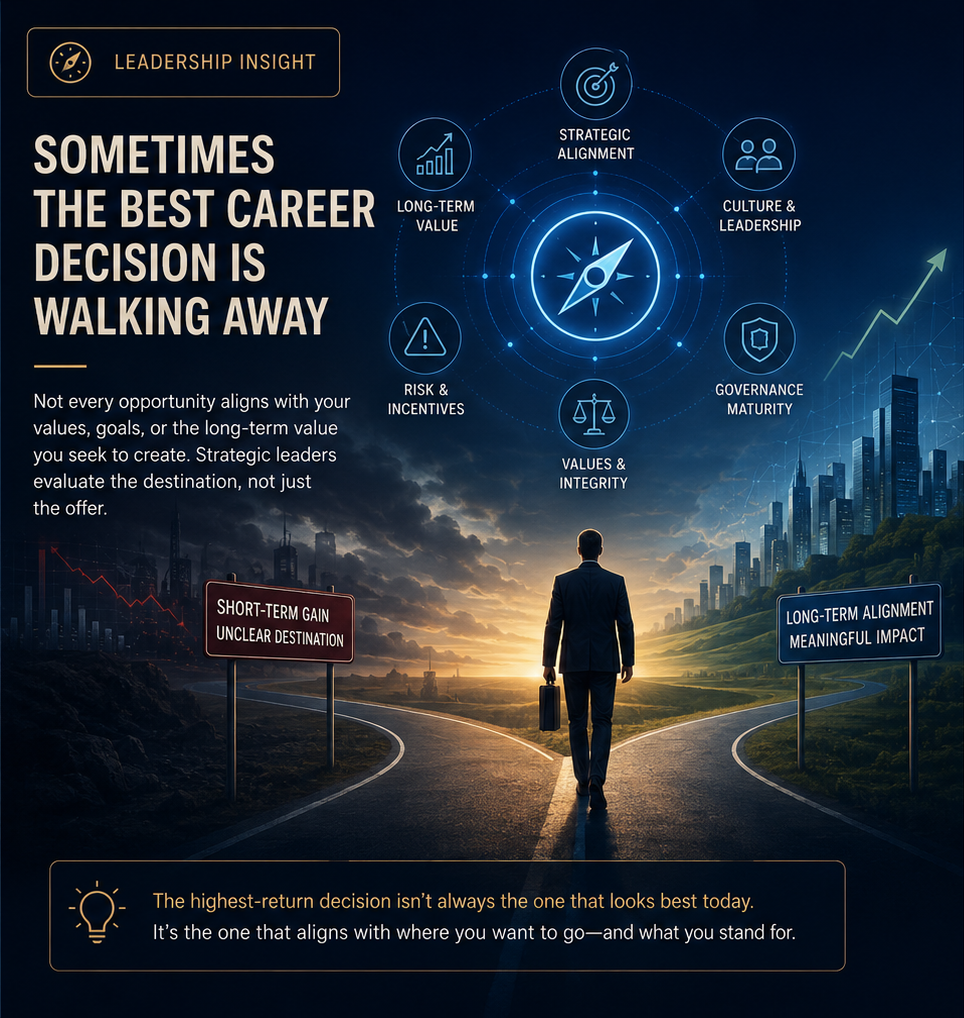
Enterprise transformation isn’t just about evaluating technology, governance, or execution. It’s also about evaluating opportunity—and recognizing when an opportunity isn’t aligned with your long-term objectives.
Throughout my career, I’ve evaluated technology investments, modernization initiatives, governance frameworks, and operational transformation programs. Each required balancing risk against potential value.
Career decisions deserve the same discipline.
Recently, I found myself evaluating an executive opportunity that, on paper, appeared highly attractive. The role aligned with my experience, the compensation was competitive, and the organization was pursuing ambitious growth objectives.
As conversations progressed, however, it became clear that the decision required looking beyond the job description.
Looking Beyond the Opportunity
Every organization operates according to a business strategy.
Some are built for long-term operational excellence.
Others are built for rapid growth with the expectation that success ultimately leads to acquisition by a larger enterprise.
Neither strategy is inherently better than the other.
The important question is whether your own objectives align with the organization’s destination.
If the primary value created by years of rapid growth ultimately accrues to founders, investors, or equity holders, professionals joining without meaningful ownership should carefully consider what they expect to gain from the journey.
Experience matters.
Growth matters.
Leadership opportunities matter.
But so does understanding who ultimately participates in the value created.
Career decisions deserve the same strategic analysis we apply to enterprise investments.
Organizational Readiness Matters
Transformation initiatives rarely succeed because of technology alone.
They succeed when organizations possess the governance, leadership maturity, and collaborative culture necessary to execute change.
During any interview process, I pay close attention to indicators that reveal organizational readiness:
- Consistency of leadership messaging.
- Alignment between stated objectives and observed behaviors.
- Healthy disagreement versus persistent internal conflict.
- Commitment to collaboration over organizational politics.
- Willingness to address difficult problems objectively.
These signals often reveal far more than a polished job description.
Technology can be modernized.
Processes can be redesigned.
Culture is far more difficult to change.
Standing Firm When Your Values Are Tested
The most difficult career decisions are rarely about compensation.
They are about values.
Every technology leader will eventually encounter situations where accepting an opportunity requires overlooking concerns that conflict with personal principles or professional judgment.
Those moments define leadership.
Integrity has little meaning when decisions are easy.
Its value is demonstrated when the cost of maintaining it is real.
Standing by your principles may require declining attractive opportunities, challenging prevailing opinions, or accepting short-term uncertainty in pursuit of long-term alignment.
In my experience, those decisions are seldom regretted.
Systems Thinking Applies to Careers
One of the core principles of systems thinking is understanding incentives.
Organizations optimize for the outcomes they are designed to achieve.
Individuals should do the same.
The best career decisions consider more than today’s role or compensation package.
They examine where the organization is headed, how value will be created, who ultimately benefits from that value, and whether the environment supports both professional growth and ethical leadership.
Sometimes the highest-return decision isn’t accepting the opportunity.
Sometimes it’s recognizing that success depends on finding an organization whose strategy, culture, governance, and values align with your own.
Closing Thought
Every enterprise transformation begins with understanding the system.
Careers are no different.
The objective isn’t simply to find the next position—it’s to find the right system in which to invest your experience, your leadership, and your principles.