
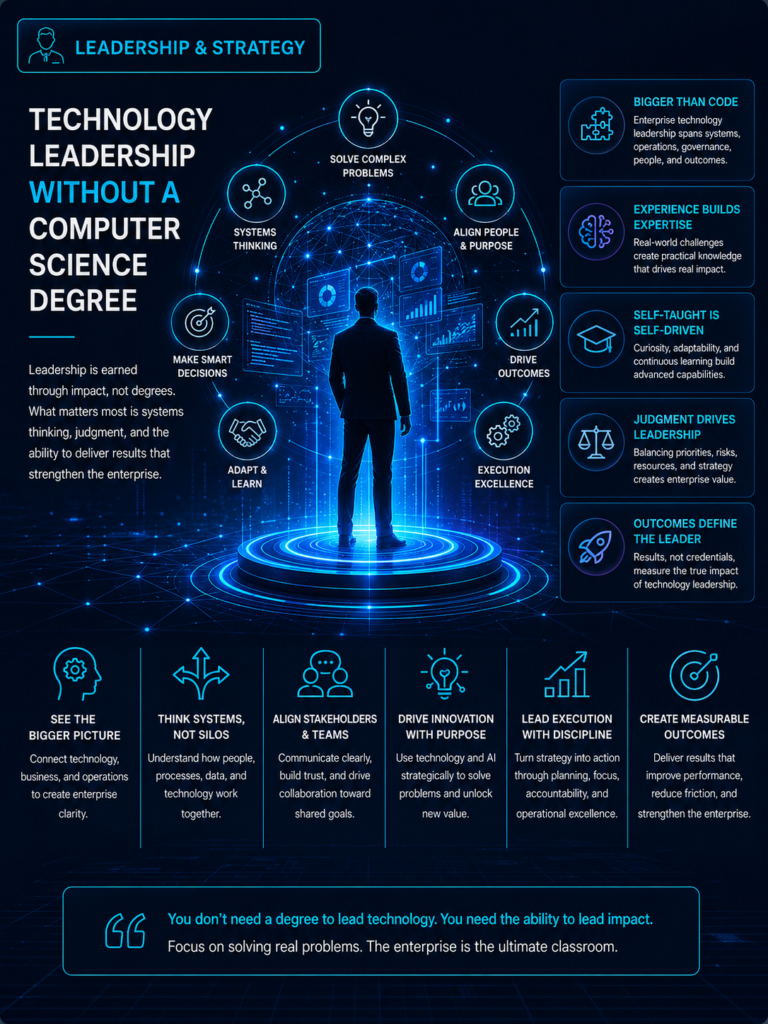
For decades, the technology industry has treated formal technical education as the primary gateway to leadership. Degrees, certifications, academic pedigree, and specialized credentials often became proxies for capability, credibility, and expertise.
Yet many of the most effective enterprise technology leaders developed their skills differently.
Not through theory first.
Through execution.
Technology leadership is ultimately not about memorizing syntax, passing exams, or mastering isolated technical frameworks. It is about understanding how complex systems operate, how organizations make decisions, how technology enables business outcomes, and how execution disciplines transform ideas into measurable results.
Those capabilities are often built through experience rather than formal academic pathways.
Enterprise Technology Is Bigger Than Software Development
One of the biggest misconceptions in enterprise technology is the belief that all leadership paths should originate from software engineering.
Software development is critically important.
But enterprise delivery requires far more than coding.
Large-scale technology transformation involves:
- Governance
- Financial management
- Operational intelligence
- Delivery orchestration
- Data integration
- Risk management
- Organizational alignment
- Vendor coordination
- Stakeholder communication
- Reporting systems
- Execution visibility
- Strategic prioritization
- Business process modernization
These are systems problems as much as they are technical problems.
The leaders who succeed in these environments are often the individuals capable of seeing the entire enterprise ecosystem rather than only isolated technical components.
Execution Experience Creates Operational Understanding
Many technology professionals develop enterprise expertise through direct operational exposure.
They learn by:
- Recovering failing implementations
- Managing large-scale migrations
- Designing reporting systems
- Building automation frameworks
- Leading PMOs
- Coordinating cross-functional delivery
- Resolving operational bottlenecks
- Navigating governance structures
- Supporting financial transformation
- Integrating disconnected systems
- Solving real organizational problems under pressure
This type of experience develops a practical understanding of enterprise complexity that cannot always be replicated in formal academic environments.
Operational intelligence is learned through operational exposure.
Operational Discipline Transfers Across Industries
Some of the strongest enterprise technology leadership capabilities are developed outside traditional technology environments.
Before entering enterprise technology, my professional foundation was built in power generation — specifically within the operational environment of a nuclear power plant operating under Nuclear Regulatory Commission (NRC) standards.
That environment demanded:
- Procedural discipline
- Operational accountability
- Risk awareness
- Systems thinking
- Logic-based troubleshooting
- Governance adherence
- Escalation management
- Situational awareness
- Precision execution
- Structured decision-making under pressure
Nuclear operations function through tightly integrated systems where small failures can create significant downstream consequences. Teams operate within highly governed processes designed to reduce operational risk, improve reliability, maintain visibility, and ensure consistent execution.
Those same principles apply directly to enterprise technology environments.
Large-scale technology organizations are also interconnected operational systems. They contain dependencies, governance structures, execution risk, escalation paths, operational bottlenecks, reporting requirements, and human coordination challenges that must function together reliably under constant change.
The industries may differ, but the operational dynamics are remarkably similar.
The ability to understand complex systems, follow disciplined execution frameworks, analyze logic flows, manage operational risk, and maintain organizational visibility became a powerful foundation for later work in enterprise technology transformation, PMO leadership, operational intelligence, automation, and large-scale financial systems modernization.
In many ways, the transition into enterprise technology was not a departure from operational systems thinking.
It was an extension of it.
Self-Taught Does Not Mean Less Technical
There is a persistent but outdated assumption that self-taught professionals are somehow less capable technically than traditionally educated peers.
In reality, many enterprise technologists build highly advanced capabilities independently because enterprise environments force continuous adaptation.
Technology changes too quickly for static learning models alone to remain sufficient.
Self-directed professionals often become highly skilled in:
- Systems integration
- Automation
- Reporting architecture
- Operational analytics
- Workflow design
- Enterprise tooling
- AI enablement
- Data transformation
- Process optimization
- Financial systems
- Infrastructure modernization
- Governance frameworks
Not because they followed a prescribed curriculum, but because solving business problems required it.
The enterprise itself became the classroom.
Technology Leadership Is Primarily About Judgment
As organizations become more complex, leadership value shifts away from isolated technical specialization and toward judgment.
Enterprise leaders must constantly evaluate:
- Tradeoffs
- Priorities
- Risks
- Dependencies
- Organizational readiness
- Governance implications
- Resource constraints
- Operational impacts
- Strategic alignment
- Delivery sequencing
Technical knowledge matters.
But judgment determines outcomes.
The ability to synthesize operational, technical, financial, and organizational realities into executable strategy becomes increasingly important at scale.
That capability is often developed through years of enterprise execution experience rather than academic specialization alone.
AI Will Further Change The Definition Of Technical Leadership
Artificial intelligence is already reshaping how enterprise technology work is performed.
Tasks that once required deep specialization are increasingly being automated, accelerated, or augmented through AI systems.
As this transition accelerates, the highest-value leadership capabilities will increasingly center around:
- Systems thinking
- Operational intelligence
- Governance
- Strategic integration
- Business alignment
- Organizational design
- Decision-making
- Execution management
- Human coordination
- Enterprise adaptability
In other words:
The future technology leader may look less like a narrow technical specialist and more like an enterprise systems architect capable of aligning technology, operations, governance, automation, and business outcomes into a coherent execution model.
Enterprise Value Is Measured By Outcomes
At the enterprise level, organizations ultimately evaluate leadership based on results.
Not resumes.
Not credentials.
Not titles.
Outcomes.
Did the implementation succeed?
Did operational visibility improve?
Did governance become stronger?
Did automation reduce friction?
Did reporting become more intelligent?
Did the organization become more effective?
Technology leadership is ultimately about creating measurable enterprise capability.
And there are many paths to developing the skills required to do that successfully.